Description
+ Include: videos + file sub vtt, size: GB
+ Target Audience: Primary Care Physicians, Pulmonologists, Palliative Care Specialists, Infectious Disease Specialists
+ Sample video: contact me for sample video
+ Information:
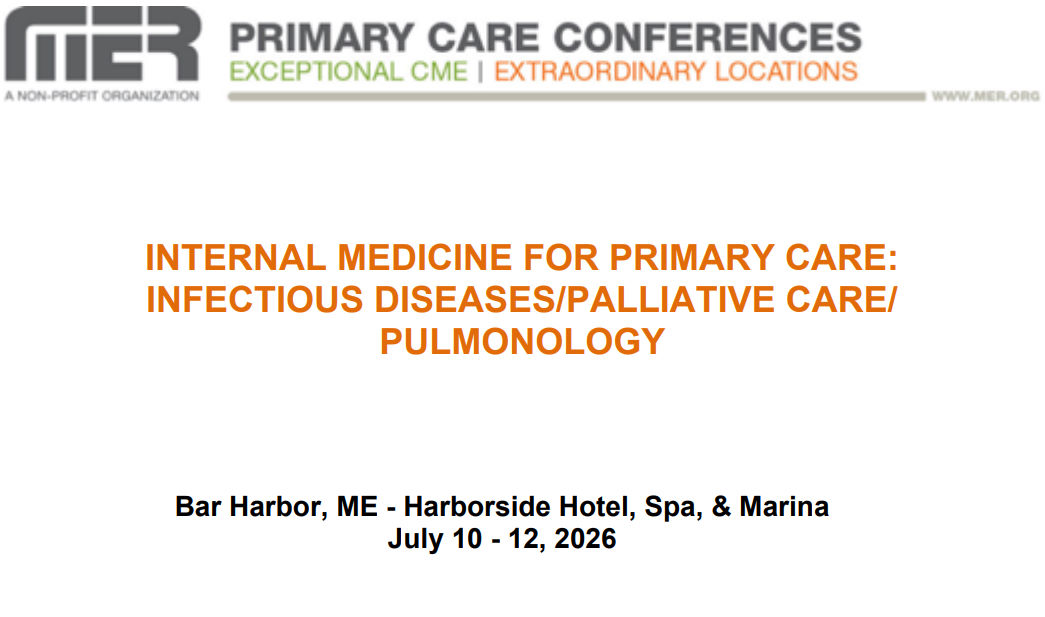
The Internal Medicine for Primary Care: Infectious Diseases/Palliative Care/Pulmonology conference is an educational event organized by Medical Education Resources (MER), a non-profit organization. This primary care conference is scheduled for July 10-12, 2026, and will be held at the Harborside Hotel, Spa, & Marina in Bar Harbor, ME.
Learning Objectives
Upon completion of this program, participants should be better able to:
-
Diagnose and manage patients with asthma.
-
Design treatment strategies reflective of current evidence-based medicine for common respiratory infections.
-
Describe the current therapeutic management of COPD.
-
Discuss diagnosis and screening strategies as well as treatment plans for lung nodules and lung cancer.
-
List details about the Medicare hospice benefit.
-
Describe the primary care approach to palliative medicine including symptom management.
-
Recognize the importance of prognosis in decision making for seriously ill patients.
-
Define and establish goals of care with patients and their families.
-
Review epidemiology and microbiology of skin and soft tissue infections (SSTI).
-
Evaluate the severity of diarrhea and evaluate the need for treatment.
-
Discuss emerging infectious diseases including resurgence of vaccine-preventable diseases, zoonoses, and diseases related to animal exposures.
-
List goals of an antimicrobial stewardship program and strategies for antimicrobial treatment.
Target Audience
- This program is targeted to office-based primary care providers and other health professionals with updates in primary care medicine.
- Best for Primary Care Physicians, Pulmonologists, Palliative Care Specialists, and Infectious Disease Specialists.
Topics
-
Pulmonology – Asthma: The medical impact of asthma; fundamental role of inflammation, with possible scarring and irreversible loss of lung function; practical points of diagnosis; goal setting management based on levels of severity; risk factors for mortality and treatment in the acute setting; management options for the difficult to control asthmatic patient.
-
Pulmonology – Controversies in the Treatment of Common Respiratory Infections: Acute and chronic bronchitis; pneumonia (community versus hospital-acquired); role of the Pneumonia Severity Index score in determining indication for hospitalization; cost- effective use of antibiotics; clinical significance of drug resistance; guidelines for management.
-
Pulmonology – COPD: Definition; pathophysiology; early detection and intervention; risk reduction; management update including new modalities (including lung volume reduction surgery) and the role of inhaled corticosteroids and domiciliary oxygen.
-
Palliative – Medicare Hospice Benefit: Which patients are eligible? What is palliative care? What does the Medicare benefit provide for patients and families?.
-
Palliative – Palliative Care for the PCP: Symptom Management: Symptom management; Symptom management of dyspnea and cough, pain, nausea and vomiting, constipation, and agitation, at the end of life.
-
Palliative – Prognostication for the PCP: Estimating life expectancy for patients with life-limiting illnesses such as CHF, Alzheimer’s dementia, Parkinson’s disease, end stage renal disease.
-
Palliative – Addressing Goals of Care: Definition of POA, DNR, DNI, DNH, MOLST, POLST; Techniques on how to address goals of care, both in acute crisis as well as when the patient has chronic issues.
-
Pulmonology – Lung Cancer Screening & Pulmonary Nodules: Appropriate use of the new lung cancer screening recommendations; Fleischner Society guidelines and American College of Chest Physician Lung Cancer guidelines; approach to definitive evaluation and management strategies.
-
Infectious Diseases – Skin & Soft Tissue Infections: Presentation on important skin and soft-tissue infections and their prompt recognition, emphasizing evaluation and management strategies.
-
Infectious Diseases – Gastrointestinal Infections & Clostridiodes Difficile: Presentation on important enteric pathogens and their recognition, diagnosis and management; special emphasis on clostridiodes difficile colitis and related updates from the ID and infection control literature.
-
Infectious Diseases – Emerging Infectious Diseases: Novel influenza viruses, resurgence of vaccine-preventable diseases, zoonoses and disease related to animal exposures (including vectors such as mosquitoes that bear west Nile virus and dengue), bioterrorism and food/waterborne illness.
-
Infectious Diseases – Antimicrobial Stewardship and Multidrug Resistance: Definition of an antimicrobial stewardship program (ASP); Concepts of the antimicrobial stewardship program; Four goals of antimicrobial stewardship; Most recent additions to the antimicrobial armamentarium.




Reviews
There are no reviews yet.