Description
+ Include: videos + file sub vtt, size: GB
+ Target Audience: Internists, Primary Care Physicians, Family Physicians, Gynecologists, Obstetricians and Gynecologists (OB-GYNs), Pulmonologists, and Neurologists
+ Sample video: contact me for sample video
+ Information:
-
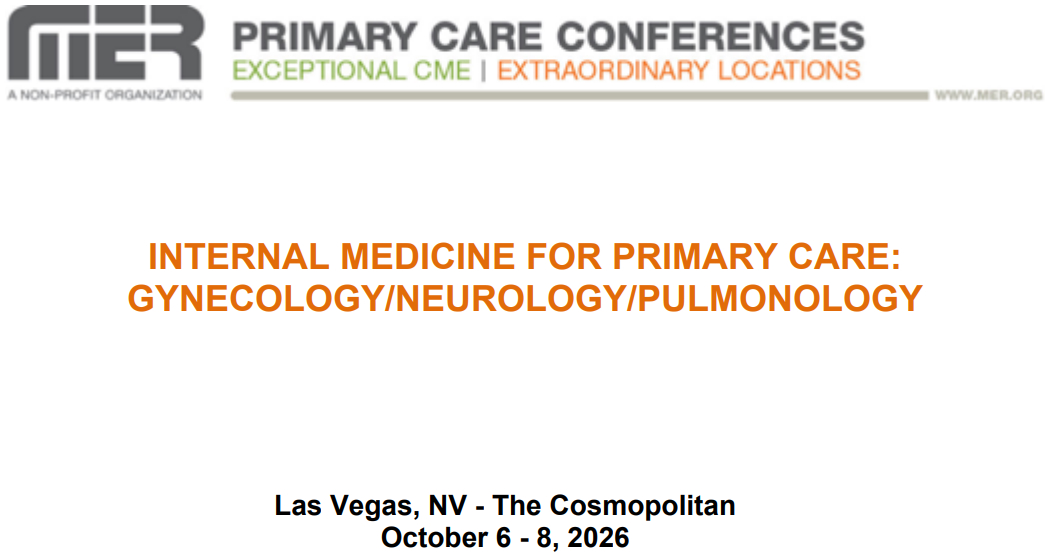
Conference Title: Internal Medicine for Primary Care: Gynecology/Neurology/Pulmonology
-
Organizer: Medical Education Resources (MER) – A Non-Profit Organization
-
Dates: October 6–8, 2026
-
Location: Las Vegas, NV – The Cosmopolitan
Learning Objectives
Upon completion of this program, participants should be better able to:
-
Identify evidence-based tools to determine best practices in incorporating all necessary elements in the annual women’s health visit
-
Assess and manage abnormal uterine bleeding
-
Discuss the current evidence and recommendations regarding breast cancer screening
-
Discuss menopausal transition and the risks/benefits of treatment options
-
Diagnose and manage patients with asthma
-
Design treatment strategies reflective of current evidence-based medicine for common respiratory infections
-
Describe the current therapeutic management of COPD
-
Discuss diagnosis and screening strategies as well as treatment plans for lung nodules and lung cancer
-
Utilize history and physical examination to distinguish weakness from non-specific symptoms
-
Discuss evidence-based management options for Alzheimer’s disease
-
Evaluate weakness and recognize cardinal features of Parkinson’s disease as well as other movement disorders
-
Describe the differential diagnosis and treatment options for migraine headaches
Target Audience
This program is targeted to office-based primary care providers and other health professionals with updates in primary care medicine.
Best for Internists, Primary Care Physicians, Family Physicians, Gynecologists, Obstetricians and Gynecologists (OB-GYNs), Pulmonologists, and Neurologists.
Topics
Tuesday, October 6, 2026
-
7:00 am: Check-In and Breakfast
-
7:30 am – 8:30 am | Gynecology: Annual Exam for Women
-
Best practices in offering annual pelvic examinations in asymptomatic non-pregnant women; Determination of who should be offered a clinical breast exam as a routine part of the annual women’s health exam; The principal elements of the annual women’s health visit: screening, vaccinations, evaluation of health risks and needs, counseling; Evidence-based tools to guide components of the annual women’s health visit based on age and health needs
-
-
8:30 am – 9:30 am | Gynecology: Abnormal Uterine Bleeding
-
Overview of normal/abnormal menstrual physiology/profile; Menstrual disturbances; Ovulatory and anovulatory uterine bleeding; Other menstrual abnormalities; Diagnosis and appropriate treatment options
-
-
9:30 am – 9:40 am: Coffee Break
-
9:40 am – 10:40 am | Gynecology: Breast Cancer Screening and Risk Assessment
-
Comparison of recent breast cancer screening recommendations from U.S. Preventive Services Task Force, ACOG/ACS/NCCN, including a discussion of risks and benefits of screening at various ages; Review of the new USPSTF guideline on BRCA-related cancer: risk assessment, genetic counseling, and genetic testing, including risk assessment tools for women with a personal or family history of breast, ovarian and related cancers
-
-
10:40 am – 11:40 am | Pulmonology: Asthma
-
The medical impact of asthma; fundamental role of inflammation, with possible scarring and irreversible loss of lung function; practical points of diagnosis; goal setting management based on levels of severity; risk factors for mortality and treatment in the acute setting; management options for the difficult to control asthmatic patient
-
-
11:40 am – 12:40 pm | Pulmonology: Controversies in the Treatment of Common Respiratory Infections
-
Acute and chronic bronchitis; pneumonia (community versus hospital-acquired); role of the Pneumonia Severity Index score in determining indication for hospitalization; cost-effective use of antibiotics; clinical significance of drug resistance; guidelines for management
-
-
12:40 pm: Session Adjourns
Wednesday, October 7, 2026
-
7:00 am: Arrival and Breakfast
-
7:30 am – 8:30 am | Pulmonology: COPD
-
Definition; pathophysiology; early detection and intervention; risk reduction; management update including new modalities (including lung volume reduction surgery) and the role of inhaled corticosteroids and domiciliary oxygen
-
-
8:30 am – 9:30 am | Pulmonology: Lung Cancer Screening & Pulmonary Nodules
-
Appropriate use of the new lung cancer screening recommendations; Fleischner Society guidelines and American College of Chest Physician Lung Cancer guidelines; approach to definitive evaluation and management strategies
-
-
9:30 am – 9:40 am: Coffee Break
-
9:40 am – 10:40 am | Gynecology: Menopause Transition and Hormone Replacement Therapy
-
Symptoms of menopause, including hot flashes, night sweats, and atrophy; Menopause syndromes, including osteoporosis, breast cancer, cardiac disease, and colon cancer; Estrogen analogs; Counseling patients in options and alternatives to hormone therapy; Designer estrogens; SERMS; HRTs; Discussion of risks and benefits, especially in breast cancer and CHD
-
-
10:40 am – 11:40 am | Neurology: Evaluating Weakness
-
Using the history and physical examination to distinguish weakness from non-specific symptoms; characteristics of neurological diseases that produce weakness; presentations of representative diseases of the nervous system
-
-
11:40 am – 12:40 pm | Neurology: Alzheimer’s & Other Dementias
-
Review changes in cognition with normal aging; Behavioral changes that may precede early dementia; Screening tools for dementia; Characteristics of different dementia syndromes; Risks and benefits for treatment of Alzheimer Disease; Risk factors and causes of delirium, and how to reduce them; How to suspect and identify delirium; Management of the symptoms of delirium; Distinguishing delirium from dementia
-
-
12:40 pm: Session Adjourns
Thursday, October 8, 2026
-
7:00 am: Arrival and Breakfast
-
7:30 am – 8:30 am | Neurology: Parkinson’s Disease & Other Movement Disorders
-
Epidemiology; cardinal features; secondary features; pathology; neurochemistry; differential diagnosis; treatment; complication; other movement disorders; neuroleptic-induced movement disorders; chorea
-
-
8:30 am – 9:30 am | Neurology: Migraine Headaches
-
Diagnosis based on headache history; Classification and pathophysiology of migraine; Acute migraine treatment; Prophylaxis for recurrent migraine attacks; Chronic migraine, tension-type headaches, and cluster headaches; Trigeminal Neuralgia
-
-
9:30 am: Conference Adjourns


Reviews
There are no reviews yet.