Description
+ Include: videos + file sub vtt, size: GB
+ Target Audience: internists, primary care physicians, gastroenterologists, neurologists, pain management specialists, and psychiatrists
+ Sample video: contact me for sample video
+ Information:
1. Overview
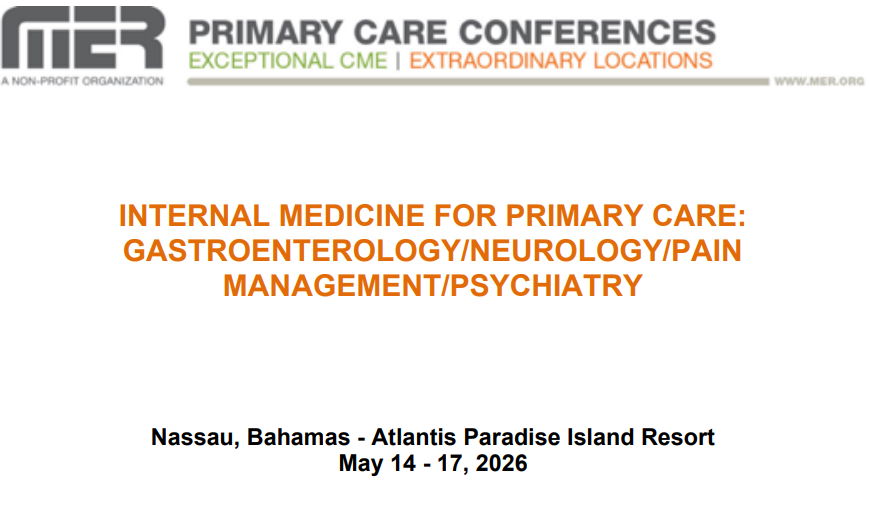
This is a primary care medical conference organized by Medical Education Resources (MER), a non-profit organization. The conference is titled “Internal Medicine for Primary Care: Gastroenterology/Neurology/Pain Management/Psychiatry”. It will take place from May 14-17, 2026, at the Atlantis Paradise Island Resort in Nassau, Bahamas.
2. Learning Objectives
Upon completion of this program, participants should be better able to:
-
Utilize history and physical examination to distinguish weakness from non-specific symptoms.
-
Discuss evidence-based management options for Alzheimer’s disease.
-
Evaluate weakness and recognize cardinal features of Parkinson’s disease as well as other movement disorders.
-
Utilize prevention and treatment strategies for cerebrovascular disorders.
-
Identify strategies to overcome the challenges of treating chronic pain.
-
Identify pharmacologic and non-pharmacologic options for the management of pain.
-
Describe the differential diagnosis of headaches and migraines.
-
Design opioid pain management strategies.
-
List current treatment recommendations for the management of lower GI bleeding.
-
Discuss the guidelines for colonoscopic colorectal cancer screening and surveillance.
-
Discuss options to prevent recurring pancreatitis.
-
Identify patients most at risk for pancreas cancer.
-
Review current evidence for the treatment of anxiety disorders.
-
Recommend appropriate pharmacologic and non-pharmacologic treatment for depression.
-
Describe strategies for identifying and treating substance use disorders.
-
Discuss mood stabilizing psychosocial and pharmacologic treatments of bipolar disorder as well as frequent co-morbid psychiatric disorders.
3. Target Audience
- This program is targeted to office-based primary care providers and other health professionals with updates in primary care medicine.
- Best for internists, primary care physicians, gastroenterologists, neurologists, pain management specialists, and psychiatrists.
4. Topics
Thursday, May 14, 2026
-
Neurology – Evaluating Weakness: Using the history and physical examination to distinguish weakness from non-specific symptoms; characteristics of neurological diseases that produce weakness; presentations of representative diseases of the nervous system.
-
Neurology – Alzheimer’s & Other Dementias: Definition; statistics; neurological changes of normal aging; pathology; etiological theories; vascular dementias; investigations; social issues; symptomatic treatment; research therapies.
-
Neurology – Parkinson’s Disease & Other Movement Disorders: Epidemiology; cardinal features; secondary features; pathology; neurochemistry; differential diagnosis; treatment; complication; other movement disorders; neuroleptic- induced movement disorders; chorea.
-
Pain – Chronic Pain Management Options for Primary Care: Treatment of common chronic pain conditions including chronic low back pain and neuropathic pain.
-
Pain – Office Procedures for Pain: Behavioral and lifestyle modifications; Medications overview; Interventional therapies; Opioids and cannabinoids overview.
Friday, May 15, 2026
-
Pain – Headaches & Migraines: Basic headache mechanisms; headache history: characteristics, precipitating factors, medical conditions; migraine: common tension, classic, treatment, complicated, cluster, sinus; trigeminal neuralgia; Giant Cell Arteritis; brain tumor; subarachnoid hemorrhage; emergency room treatment.
-
Pain – Opioid Pharmacologic Options in Chronic Pain Management: Overall safety and efficacy; Selecting and monitoring patients; Pain contracts; Regulatory issues; Urine drug testing.
-
Neurology – Cerebrovascular Disorders: Epidemiology; identifying the high-risk patient; treatment effects; transient neurological deficit: carotid, vertebrobasilar; non-specific cerebral symptoms; migraines vs. TIA; treatment options.
-
Gastroenterology – Management of Lower GI Bleeding- From Occult to Massive: The correct use and interpretation of tests for occult blood in the stool will be discussed in relation to lower GI bleeding; focus on the utility of different diagnostic and management approached to the spectrum of patients presenting with hematochezia.
-
Gastroenterology – Colorectal Cancer Screening and Surveillance: Reviews the most recent recommendations for CRC screening in the general population at average risk for CRC.
Saturday, May 16, 2026
-
Gastroenterology – Acute Pancreatitis: Etiology and Management: Recognition of acute and chronic pancreatitis; The etiology of pancreatitis and determination of next steps in management; Discussion of complications of pancreatitis and how to counsel patients on how to prevent recurrence of pancreatitis.
-
Gastroenterology – Pancreas Cancer Screening: Determination of who qualifies for pancreas cancer screening and how to refer for pancreas cancer screening; Discussion of the importance of the family history and genetic counseling; Discussion of how pancreas screening is accomplished.
-
Psychiatry – Anxiety Disorders: The nature of anxiety; Generalized anxiety disorder, panic disorder, social anxiety disorder and post-traumatic stress disorder; etiology and diagnosis; Co-occurring conditions; Treatment options for these disabling conditions.
-
Psychiatry – Depressive Disorders: History taking, diagnosis and treatment of depression across the lifespan; pharmacologic and non-pharmacologic treatment options; rational polypharmacy.
Sunday, May 17, 2026
-
Psychiatry – Substance Use Disorders: Substance abuse history-taking to encourage patient honesty; Accurate diagnosis; Use of screening tools; Brief intervention; Recovery and treatment options; Motivational interviewing; Family symptoms and codependency.
-
Psychiatry – Bipolar Spectrum Disorders: Bipolar spectrum disorders in adults as compared to youth; Comprehensive history-taking; Differential diagnosis; Co-occurring psychiatric and medical conditions; Phase specific treatment considerations and interventions.


Reviews
There are no reviews yet.