Description
+ Include: videos + file sub vtt, size: GB
+ Target Audience: Internists, Family Medicine Physicians, Rheumatologists, Geriatricians, Otolaryngologists (Head and Neck Surgeons), Urologists, Psychiatrists
+ Sample video: contact me for sample video
+ Information:
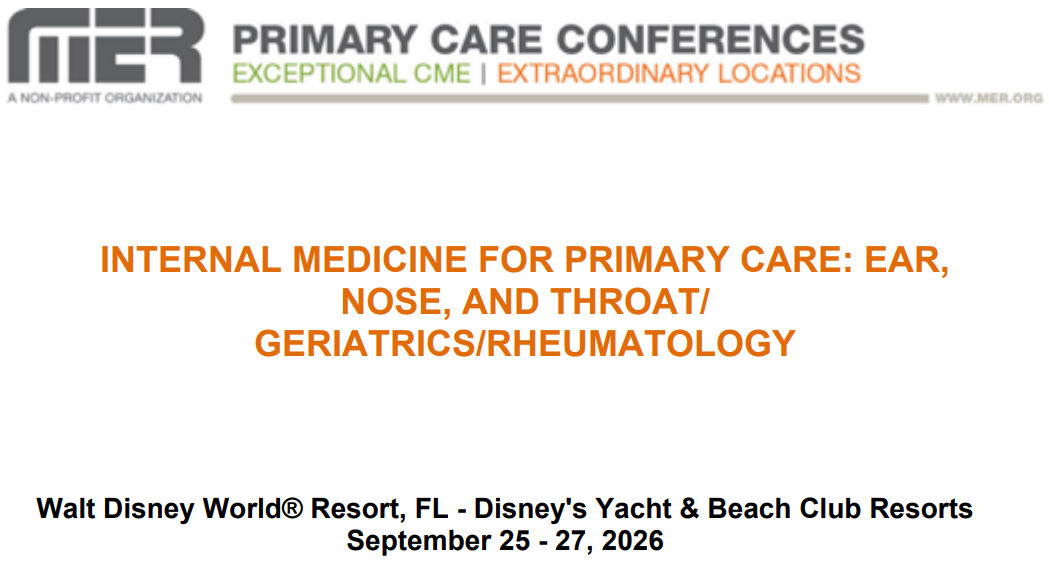
Internal Medicine for Primary Care: Ear, Nose, and Throat/Geriatrics/Rheumatology is an exceptional continuing medical education program organized by Medical Education Resources (MER). Held at Disney’s Yacht & Beach Club Resorts in Walt Disney World® Resort, Florida, this conference is designed to provide primary care clinicians with comprehensive, evidence-based updates and pragmatic management strategies across the fields of rheumatology, geriatrics, and otolaryngology (ENT). Through concise lectures, diagnostic algorithms, and clinical case reviews, attendees will gain actionable insights into differentiating inflammatory from non-inflammatory joint disorders, managing complex geriatric syndromes and cognitive decline, and evaluating urgent and common head and neck presentations such as neck masses, sinusitis, allergic rhinitis, and sudden hearing loss.
Learning Objectives
Upon completion of this program, participants should be better able to:
-
Compare and contrast inflammatory & non-inflammatory joint pain and their differential diagnoses.
-
Utilize current evidence to design treatment strategies for osteoarthritis.
-
Describe the differential diagnoses of inflammatory arthritis based on clinical presentation and laboratory workup.
-
Diagnose and treat gout and pseudogout.
-
Utilize a comprehensive geriatric assessment to identify potential issues in the elderly patient.
-
Diagnose and treat cognitive impairment, dementias, and Alzheimer’s disease.
-
Recognize and manage geriatric depression.
-
Review common lower urinary tract symptoms (LUTS) that may progress to urinary incontinence, and initiate treatment options.
-
Identify when imaging and/or referral to an ENT is necessary for patients presenting with a neck mass.
-
Recommend appropriate systemic and/or topical antimicrobial agents for the treatment of sinusitis.
-
Review the basic allergic pathways that affect the body, with particular emphasis on the nasal and sinus regions.
-
Accurately differentiate between sensorineural and conductive hearing loss.
Target Audience
This program is targeted to office-based primary care providers and other health professionals with updates in primary care medicine.
Best for Internists, Family Medicine Physicians, Rheumatologists, Geriatricians, Otolaryngologists (Head and Neck Surgeons), Urologists, Psychiatrists, and Allergists/Immunologists.
Topics
-
Friday, September 25, 2026
-
Rheumatology: Evaluating the Patient with Joint Pain (Differentiating between inflammatory and non-inflammatory joint pain; the utility of joint aspiration and lab work-up with interpretation of synovial fluid analysis; differential diagnosis of joint pain and inflammatory arthritis)
-
Rheumatology: Osteoarthritis (Pathogenesis, diagnosis, and treatment)
-
Rheumatology: Differential Diagnosis of Inflammatory Arthritis (Clinical presentation and laboratory work-up and treatment for rheumatoid arthritis, systemic lupus erythematosus, spondyloarthropathies [SPA], infectious arthritis, and systemic sclerosis; treatment of RA with DMARDs; treatment principles of SLE, Sjogren’s, SPA, and PMR)
-
Geriatrics: Approach to the Geriatric Patient (The demographics of aging and the physiologic changes in the elderly patient; medication use in the elderly including changes in age-related pharmacokinetics and pharmacodynamics and medication adherence; review of risky medications often used in elderly patients)
-
Geriatrics: Alzheimer’s & Other Dementias (Review of normal age-related changes in cognitive function as well as disorders of memory and cognition as part of dementing illness; mental status exams, including their limitations in evaluating memory; various types of dementia and the importance of an accurate diagnosis; current treatment options for various kinds of dementia; potentially reversible dementias; the responsibilities of healthcare providers in managing patients with dementia)
-
-
Saturday, September 26, 2026
-
Geriatrics: Depression: Considerations in Older Adults (Overview of depression as a common condition often seen in primary care; the many ways depression negatively impacts other healthcare issues; simple methods of recognition and managing depression in the primary care setting that can greatly improve the comfort, function, and the quality of life for older adults)
-
Geriatrics: Urological Disorders in the Older Adult (Review common lower urinary tract symptoms [LUTS] in older adults that may progress to incontinence; practical approaches to differential diagnoses and management of Stress Incontinence, Overflow Incontinence, and Overactive Bladder [OAB], leading to Urge Incontinence)
-
Rheumatology: Crystal Disease: Gout & Pseudogout (Properly diagnosing and treating crystal diseases such as gout and pseudogout)
-
ENT: Evaluation of the Neck Mass (Patients presenting with masses in the neck are challenging and worrisome; the diagnostic and therapeutic process is described; a method for evaluating the mass, guidance on when imaging studies are indicated, and when immediate or routine referral to ENT becomes appropriate is discussed)
-
ENT: Antimicrobial Therapy in Treating Sinusitis (Symptoms, signs, and examination findings helpful in diagnosing sinusitis are outlined; when to use systemic and topical agents as well as emerging resistance to these agents is discussed; imaging studies and proper referral to specialists is described with clarity)
-
-
Sunday, September 27, 2026
-
ENT: Allergic Rhinitis (The lecture will focus on a review of the basic allergic pathways that affect the body; special emphasis will be given to the nasal and sinus regions, with discussion to include diagnostic testing and modes of treatment, including avoidance, pharmacotherapy, and immunotherapy)
-
ENT: A Primary Care Approach to Sudden Hearing Loss (When a patient presents with sudden hearing loss, accurate differentiation of sensorineural versus conductive loss is essential; techniques to make that differentiation, testing and treatment strategies will be discussed; urgent treatment and when to render for audiometric testing and ENT referral will be outlined)
-


Reviews
There are no reviews yet.