Description
+ Include: videos + file sub vtt, size: GB
+ Target Audience: internists, primary care physicians, endocrinologists, gastroenterologists, nutritionists, and obesity medicine specialists
+ Sample video: contact me for sample video
+ Information:
1. Overview
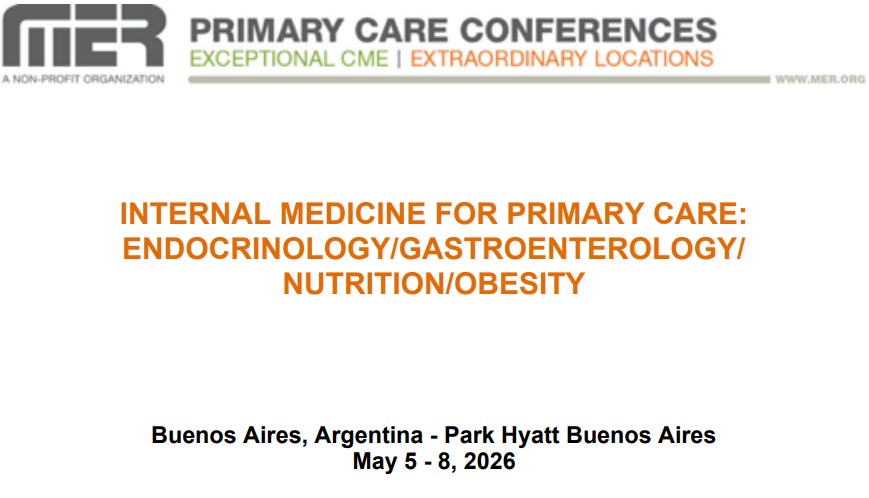
This is a primary care medical conference organized by Medical Education Resources (MER), a non-profit organization. The conference is titled “Internal Medicine for Primary Care: Endocrinology/Gastroenterology/Nutrition/Obesity”. It will take place from May 5-8, 2026, at the Park Hyatt Buenos Aires in Buenos Aires, Argentina.
2. Learning Objectives
Upon completion of this program, participants should be better able to:
-
Develop patient-specific treatment plans for the management of type 2 diabetes.
-
Diagnose and tailor treatment strategies for type 1 and type 2 diabetes.
-
Interpret the diagnostic criteria for dyslipidemia and design individualized treatment.
-
Identify the risks of abnormal thyroid function.
-
Explain the underlying mechanisms and physiological processes that contribute to the development and progression of obesity, including the roles of genetics, hormones, metabolism, and environmental factors.
-
Discuss non-surgical obesity treatment options.
-
List the advantages and disadvantages of surgical options and the post-surgery care of patients.
-
Describe the approach to patient management after bariatric surgery.
-
Discuss how popular diets and nutritional science can lead to healthier lifestyles.
-
Identify expectations for optimal nutrition across the patient’s expected life span.
-
List strategies to modify diet and behaviors in patients with a range of health issues.
-
Describe options for personalizing a patient-specific nutrition plan to each patient.
-
List current treatment recommendations for the management of lower GI bleeding.
-
Discuss the guidelines for colonoscopic colorectal cancer screening and surveillance.
-
Recommend appropriate testing for the workup of celiac disease.
-
Describe needed testing for elevated liver function tests.
3. Target Audience
- This program is targeted to office-based primary care providers and other health professionals with updates in primary care medicine.
- Best for internists, primary care physicians, endocrinologists, gastroenterologists, nutritionists, and obesity medicine specialists.
4. Topics
Tuesday, May 5, 2026
-
Endocrinology – Type 2 Diabetes Mellitus: Diagnosis and treatment; lessons from the DCCT; managing diabetic emergencies; screening; pre-diabetes.
-
Endocrinology – Insulin Therapy for Diabetes: Treating T2DM with insulin; T1DM.
-
Endocrinology – Lipid Metabolism and Treatment: Review of the most recent American Heart Association Dietary and Lipid Guidelines; Discussion of the most recent ADA guidelines for lipid management for both primary and secondary CV prevention; Detail of treatments for elevated triglycerides and the lack of cardiovascular benefit from fish oil.
-
Obesity – Pathophysiology of Obesity: A guide to understanding practice demographics and considerations; The what and why of epigenetics; A practical guide to behavioral and medication management.
-
Obesity – Medical Management of Obesity: Overview of obesity as a disease state; Costs to the individual of being obese; Use of appetite suppressant medications and lifestyle modifications.
Wednesday, May 6, 2026
-
Obesity – Complications and Considerations of Bariatric Surgery: An overview of risks and effectiveness of bariatric surgery; Overview of potential surgical options; Potential complications; The role of support and behavior modification, nutrition, and the stages of patient management post-surgery.
-
Obesity – Patient Management Post-bariatric Surgery: The role of the clinician for support and behavior modification, nutrition, and the stages of patient management post-surgery.
-
Endocrinology – Disorders of Thyroid Function: Prevalence, diagnosis and treatment options of hypothyroidism and hyperthyroidism.
-
Nutrition – Myths vs. Science in Nutritional Trends: Approach for the Medical Professional: Discussion of how to scientifically navigate the nutritional maze of popular diets and nutritional trends; The potential nutrition benefits and pitfalls of various dietary preferences and related patient concerns; Ways nutrition affects healthy lifestyles.
-
Nutrition – Nutrition Through the Ages: Prevention and Potential Pitfalls: A working guide for a nutritional and behavioral rubric to understand what is expected (and what may undermine) optimal health from infancy through the elderly; Barriers patients face in implementing and sticking with nutritional strategies.
Thursday, May 7, 2026
-
Gastroenterology – Management of Lower GI Bleeding- From Occult to Massive: The correct use and interpretation of tests for occult blood in the stool will be discussed in relation to lower GI bleeding; focus on the utility of different diagnostic and management approached to the spectrum of patients presenting with hematochezia.
-
Gastroenterology – Colorectal Cancer Screening and Surveillance: Reviews the most recent recommendations for CRC screening in the general population at average risk for CRC.
-
Nutrition – Medical Nutrition Therapy: A Practical Approach to Diet and Disease: Science-based Nutrition and Behavioral Guide to Treating “The Big” Medical Problems that are taking over your practice; Essential (and proven) strategies to help guide patients’ diet and behaviors in the treatment of diabetes, cardiovascular disease, and GI health; Travel through the google-mess of what patients hear and why they turn to these as resources; The science-based strategies and resources that can be implemented to help patients take rational control of their health.
-
Nutrition – Cutting Edge Nutrition Innovation: A Personalized Approach: How to critically evaluate nutrition tools that patients can use to promote optimal health; Review the “latest and greatest” nutrition applications and technologies that can be used to greatly improve patients’ nutrition and health pursuits; Creation of personalized health plans based on unique, patient-specific plans, tests, and analyses.
Friday, May 8, 2026
-
Gastroenterology – Celiac Disease and Chronic Diarrhea: Millions of Americans are now on a gluten free diet. Only some of them actually have Celiac disease. We will review the workup of diarrhea and malabsorption with a focus on celiac disease; We will discuss how to diagnose celiac disease when a patient is already on a gluten free diet and an appropriate differential diagnosis.
-
Gastroenterology – Approach to Elevated Liver Function Tests: The elevation of elevated liver function tests can be challenging, how much testing is needed?; Discussion of common sources of elevated liver function tests; Recognition of Non Alcoholic Fatty Liver Disease; Hepatitis B evaluation and treatment; Hemochromatosis evaluation; A primary care perspective on Hepatitis C.



Reviews
There are no reviews yet.