Description
+ Include: videos + file sub vtt + pdf, size: GB
+ Target Audience: Primary Care Physicians, Dermatologists, Gastroenterologists, Orthopedists, Palliative Care Specialists
+ Sample video: contact me for sample video
+ Information:
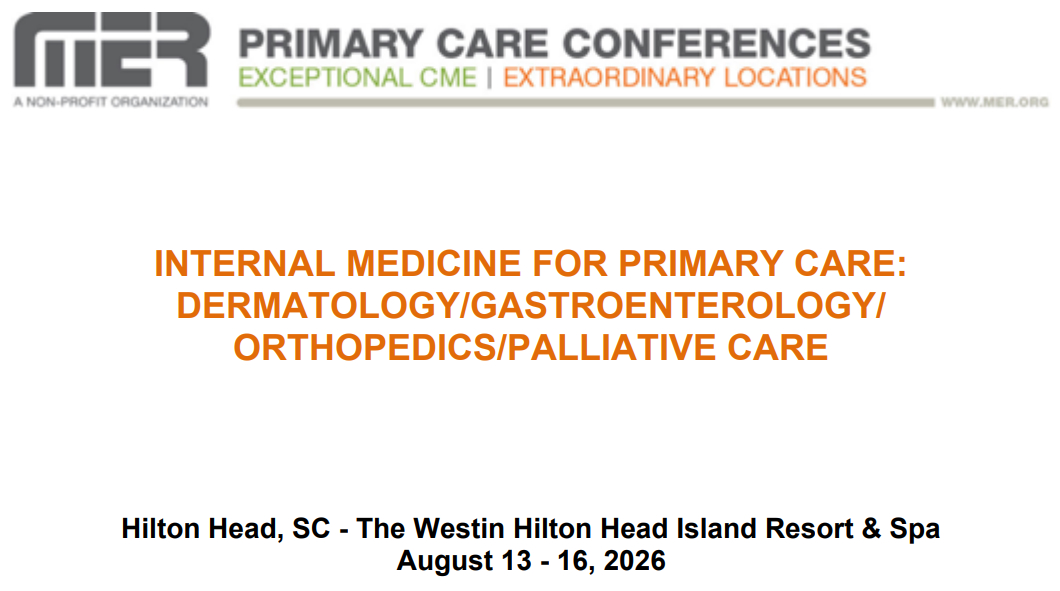
The “Internal Medicine for Primary Care: Dermatology/Gastroenterology/Orthopedics/Palliative Care” conference is scheduled to take place from August 13 to August 16, 2026, at The Westin Hilton Head Island Resort & Spa in Hilton Head, SC. Organized by Medical Education Resources (MER)
Learning Objectives
Upon completion of this program, participants should be better able to:
-
List current treatment recommendations for the management of lower GI bleeding.
-
Discuss the guidelines for colonoscopic colorectal cancer screening and surveillance.
-
Recommend appropriate testing for the workup of celiac disease.
-
List current treatment recommendations for HBV and HCV.
-
Identify cutaneous findings that serve as surrogates of internal diseases.
-
Describe the step-wise approach for the diagnosis and treatment of acne and acneiform eruptions.
-
Differentiate benign and malignant skin tumors and employ appropriate interoffice procedures.
-
Detect pre-cancerous and cancerous skin lesions.
-
List details about the Medicare hospice benefit.
-
Describe the primary care approach to palliative medicine including symptom management.
-
Recognize the importance of prognosis in decision making for seriously ill patients.
-
Define and establish goals of care with patients and their families.
-
Diagnose and treat shoulder injuries.
-
Diagnose and treat wrist, hand, and finger injuries.
-
Describe the anatomy and function of the knee joint.
-
Recognize chronic injuries and pain syndromes to the foot and ankle.
Target Audience
This program is targeted to office-based primary care providers and other health professionals with updates in primary care medicine.
Best for Primary Care Physicians, Dermatologists, Gastroenterologists, Orthopedists, and Palliative Care Specialists.
Topics
Thursday, August 13, 2026
-
Management of Lower GI Bleeding- From Occult to Massive (Gastroenterology): The correct use and interpretation of tests for occult blood in the stool will be discussed in relation to lower GI bleeding; focus on the utility of different diagnostic and management approached to the spectrum of patients presenting with hematochezia.
-
Colorectal Cancer Screening and Surveillance (Gastroenterology): Reviews the most recent recommendations for CRC screening in the general population at average risk for CRC.
-
Celiac Disease and Chronic Diarrhea (Gastroenterology): Millions of Americans are now on a gluten free diet. Only some of them actually have Celiac disease. We will review the workup of diarrhea and malabsorption with a focus on celiac disease; We will discuss how to diagnose celiac disease when a patient is already on a gluten free diet and an appropriate differential diagnosis.
-
Skin Manifestations of Systemic Disease (Dermatology): Skin will often reflect signs of systemic diseases, be useful for diagnosis, or suffer from a complication of disease or its treatment; Diagnosis of rheumatologic, endocrine, gastrointestinal, and psychologic conditions based on cutaneous findings.
-
Acne and Acneiform Eruptions (Dermatology): Identification of noninflammatory open or closed comedones and inflammatory lesions; Determination of treatment therapies based on acne grading scale; Bacterial folliculitis, drug-induced acne, hidradenitis suppurativa, miliaria, perioral dermatitis, pseudofolliculitis barbae, rosacea, seborrheic dermatitis; Topical and systemic therapy.
Friday, August 14, 2026
-
Hepatitis B and C Management (Gastroenterology): HBV screening: whom to screen, whom to vaccinate; management of patients with decompensated hepatitis B related liver disease; treatment in special populations.
-
Benign Skin Tumors (Dermatology): Proper diagnosis and treatment of common benign tumors; Biopsies and histopathologic examination; Nevi, seborrheic keratosis keloids, hemangiomas and miscellaneous tumors; When to refer.
-
Premalignant and Malignant Skin Tumors (Dermatology): Recognition of precursors of malignancies; Excisional and punch biopsies; Actinic keratosis, Bowen’s disease, squamous cell carcinoma, basal cell carcinoma, melanoma and other selected tumors; Risk reduction education.
-
Medicare Hospice Benefit (Palliative): Which patients are eligible? What is palliative care? What does the Medicare benefit provide for patients and families?
-
Palliative Care for the PCP: Symptom Management (Palliative): Symptom management; Symptom management of dyspnea and cough, pain, nausea and vomiting, constipation, and agitation, at the end of life.
Saturday, August 15, 2026
-
The Shoulder: Anatomy, Common Injuries, and Exam Techniques (Orthopedics): Rotator cuff syndrome; impingement, frozen shoulder; subacromial bursitis; bicipital tendonitis; A-C joint disease.
-
Wrist, Hand, and Fingers (Orthopedics): Carpal tunnel, CMC arthritis thumb, ganglion cyst, trigger finger, de Quervains disease.
-
The Knee: Anatomy, Common Injuries, and Exam Techniques (Orthopedics): ACL, meniscus, MRI; common sports injuries; osteoarthritis and hyaluronan; bursitis: prepatellar, pesanserine; baker’s cyst; joint injection/X-ray interpretation; pediatrics.
-
Ankle and Foot (Orthopedics): This presentation will address a series of common acute and chronic injuries and pain syndromes to the foot and ankle as they would present in the primary care setting. The focus will be on developing a working differential diagnosis based on the historical mechanism of injury and exam findings.
Sunday, August 16, 2026
-
Prognostication for the PCP (Palliative): Estimating life expectancy for patients with life-limiting illnesses such as CHF, Alzheimer’s dementia, Parkinson’s disease, end stage renal disease.
-
Addressing Goals of Care (Palliative): Definition of POA, DNR, DNI, DNH, MOLST, POLST; Techniques on how to address goals of care, both in acute crisis as well as when the patient has chronic issues.


Reviews
There are no reviews yet.