Description
+ Include: videos + file sub vtt, size: GB
+ Target Audience: Primary Care Physicians, Cardiologists, Geriatricians, and Pain Management Specialists
+ Sample video: contact me for sample video
+ Information:
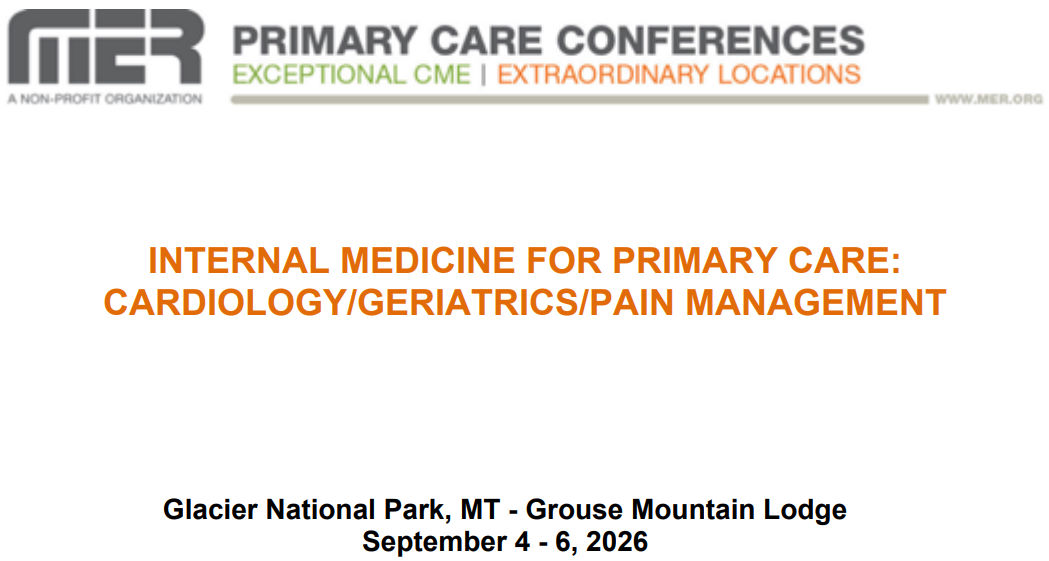
The Internal Medicine for Primary Care: Cardiology/Geriatrics/Pain Management conference, organized by Medical Education Resources (MER), is scheduled for September 4-6, 2026, at the Grouse Mountain Lodge in Glacier National Park, Montana. This continuing medical education event provides the healthcare team with comprehensive clinical updates and evidence-based strategies across cardiology, geriatrics, and pain management to improve overall patient care.
Learning Objectives
-
Implement lifestyle changes as well as lipid and cholesterol guidelines for the prevention of CAD.
-
Describe the work-up, risk assessment and test selection of patients with suspected CAD.
-
Implement treatment strategies reflective of recent guidelines and current evidence based medicine for heart failure.
-
Describe current diagnostic and treatment approaches to arrhythmias and atrial fibrilation.
-
Review common lower urinary tract symptoms (LUTS) that may progress to urinary incontinence, and initiate treatment options.
-
Review behavioral and medication interventions for dementia and Alzheimer Disease.
-
Evaluate hypertension in both younger and older adults, differentiate risks and goals of treatment, and recommend appropriate interventions.
-
Utilize discussion and case-based learning to further incorporate treatment options for hypertension into practice.
-
Differentiate treatment options for nociceptive and neuropathic pain.
-
Discuss strategies to diagnose and treat complex regional pain syndrome.
-
Recognize and treat multi system disease in the primary care setting.
-
Describe neurostimulation options for treating chronic pain.
Target Audience
This program is targeted to office-based primary care providers and other health professionals with updates in primary care medicine.
Best for Primary Care Physicians, Cardiologists, Geriatricians, and Pain Management Specialists.
Topics
-
Primary Prevention of Cardiometabolic CVD: Definitions; AHA/ACC and other lipid guidelines updates; HDL Cholesterol: The good cholesterol?; Metabolic syndrome and/or obesity; Who needs treatment and how much; The role of lifestyle changes, exercise and cardiac rehabilitation; Drug therapy updates; Risk calculation; Role of pooled equations for risk estimates.
-
Work-up of Patients with Suspected CAD: Risk factor evaluation and risk assessment models; 2021 ACC/AHA Chest Pain Guidelines; Test selection including ECG, echo, nuclear and newer imaging modalities (including discussion of appropriate use criteria–AUC); The usefulness of CT scanning; The role of bio markers and EBCT; Suspected CAD in special populations (women, diabetics, the elderly).
-
Heart Failure: Etiologies and stages of heart failure; ACC/AHA Heart Failure Guidelines; Heart failure with reduced EF (HFrEF) and heart failure with preserved EF (HFpEF); Determining patients for referral using biomarkers, eg NT Pro BNP; Treatment options: ACE inhibitors, ARBS, ARNI, beta blockers, mineralocorticoid receptor antagonists, SGLT2i; The role of devices (ICD and/or CRT) in treatment and antiplatelet drugs; Issues related to the hospitalized patient with acute decompensated heart failure and readmissions.
-
Urological Disorders in the Older Adult: Review common lower urinary tract symptoms (LUTS) in older adults that may progress to incontinence; Practical approaches to differential diagnoses and management of Stress Incontinence, Overflow Incontinence, and Overactive Bladder (OAB), leading to Urge Incontinence.
-
Dementia: A Critical Review of Treatment and Prevention: An evidence-based review of how to prevent and treat dementia, with a focus on the risks and benefits of new treatments for Alzheimer Disease; How to support patients who are considering new treatments.
-
Controversies in the Management of Hypertension in Older Adults: Best evidence for treatment goals for hypertension in diabetics and those with previous stroke; Controversial evidence for the various guidelines for diagnosing and treating hypertension in older adults; Best evidence-based medications for hypertension.
-
Hypertension Discussion and Q&A: Interactive review of the principles of hypertension diagnosis and treatment in older adults, and audience questions further clarifying the topic.
-
Arrhythmias: Types and symptoms of arrhythmias; Approach to the patient: when to treat, when to refer, when to admit; Evaluation of the patient with palpitations; Atrial fibrilation: the use of anticoagulants indications, CVA risk scores, warfarin vs newer oral anticoagulants, controlling heart rate vs rhythm; Ventricular and other arrhythmias: when are they serious.
-
Good Pain and Bad Pain: Nociceptive vs neuropathic pain; How a clinician can tell the difference and strategies to implement to treat them differently.
-
Complex Regional Pain Syndrome: Diagnostic and treatment tools for treating this often misdiagnosed and devastating pain condition.
-
Multi System Disease: Sometimes pain is just the tip of the iceberg; Strategies for making an accurate clinical diagnosis and formulating a successful treatment plan when symptoms don’t fit neatly into the box.
-
Implantable Neuromodulation: An introduction to stimulators and intrathecal pumps; Mechanism of action and when are they indicated.



Reviews
There are no reviews yet.