Description
+ Include: videos + file sub vtt + pdf, size: GB
+ Target Audience: Primary Care Physicians, Allergists, Immunologists, Geriatricians, Psychiatrists
+ Sample video: contact me for sample video
+ Information:
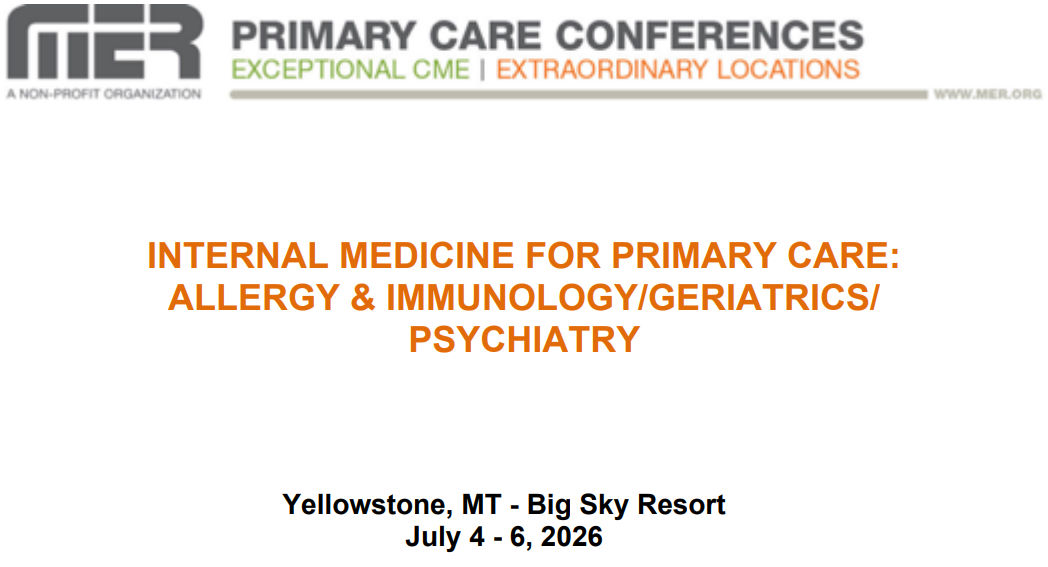
The “Internal Medicine for Primary Care: Allergy & Immunology/Geriatrics/Psychiatry” conference is a continuing medical education event hosted by Medical Education Resources (MER), a non-profit organization. It will take place from July 4-6, 2026, at the Big Sky Resort in Yellowstone, MT.
Learning Objectives
Upon completion of this program, participants should be better able to:
-
Compare the benefits and side effect profiles of pharmacologic treatment options for ADHD.
-
Discuss mood stabilizing psychosocial and pharmacologic treatments of bipolar disorder as well as frequent co-morbid psychiatric disorders.
-
Review current evidence for the treatment of anxiety disorders.
-
Describe strategies for identifying and treating substance use disorders.
-
Describe how to efficiently and cost effectively manage patients with asthma, rhinitis, and sinusitis.
-
Outline the management of anaphylactic reactions and indications for immunotherapy.
-
Discuss epidemiology, risk factors, and causes of atopic dermatitis.
-
Describe strategies for rediscovering the joy in the practice of medicine.
-
Utilize a comprehensive geriatric assessment to identify potential issues in the elderly patient.
-
Discuss interpretation of bone scans and identify risk assessment.
-
Diagnose and treat cognitive impairment, dementias, and Alzheimer’s disease.
-
Discuss strategies for the management of difficult behaviors in patients with dementia without the use of psychotropic medications.
Target Audience
- This program is targeted to office-based primary care providers and other health professionals with updates in primary care medicine. Best for Primary Care Physicians, Allergists, Immunologists, Geriatricians, and Psychiatrists.
Topics
-
The Complexity of Adult ADHD: ADHD in adults with an emphasis on symptom identification; Co-occurring conditions; Psychiatric and medical differential diagnosis; evidence-based and FDA approved pharmacological treatments.
-
Bipolar Spectrum Disorders: Bipolar spectrum disorders in adults as compared to youth; Comprehensive history-taking; Differential diagnosis; Co-occurring psychiatric and medical conditions; Phase specific treatment considerations and interventions.
-
Anxiety Disorders: The nature of anxiety; Generalized anxiety disorder, panic disorder, social anxiety disorder and post-traumatic stress disorder; etiology and diagnosis; Co-occurring conditions; Treatment options for these disabling conditions.
-
Asthma, Allergic Rhinitis, and Sinusitis for Primary Care: Lecture focused on gaining a working knowledge of how to efficiently and cost effectively manage patients with asthma, rhinitis, and sinusitis.
-
Food Allergies and Hymenoptera Allergies: Primary care focused discussion of food and venom allergies including gaining a working knowledge of how to efficiently and cost effectively manage patients with hymenoptera hypersensitivity.
-
Urticaria, Angioedema, Eczema and Contact Dermatitis: Lecture focused on gaining a working knowledge of how to efficiently and cost effectively manage patients with various atopic skin conditions.
-
Burnout and Provider Wellness: Strategies that clinicians and healthcare providers can institute with ease to combat the challenges and pitfalls of the current healthcare system.
-
Substance Use Disorders: Substance abuse history-taking to encourage patient honesty; Accurate diagnosis; Use of screening tools; Brief intervention; Recovery and treatment options; Motivational interviewing; Family symptoms and codependency.
-
Approach to the Geriatric Patient: The demographics of aging and the physiologic changes in the elderly patient; Medication use in the elderly including changes in age-related pharmacokinetics and pharmacodymamics and medication adherence; Review of risky medications often used in elderly patients.
-
Osteoporosis in the Older Adult: Review the epidemiology and pathophysiology of osteoporosis along with interpretation of DEXA scans and FRAX risk assessment; up-to-date therapeutic options.
-
Alzheimer’s & Other Dementias: Review of normal age-related changes in cognitive function as well as disorders of memory and cognition as part of dementing illness; Mental status exams, including their limitations in evaluating memory; Various types of dementia and the importance of an accurate diagnosis; Current treatment options for various kinds of dementia; Potentially reversible dementias; The responsibilities of healthcare providers in managing patients with dementia.
-
Managing Behavior Problems in Dementia Patients: Review of common behavior disorders often seen in patients with dementia; Behavioral techniques which have shown to be effective in managing some of the behavior disorders in patients with Alzheimer’s and other dementias, focusing on the management of these patients without the use of psychotropic medications; Examples of behavior disturbances along with the behavior management technique which was effective in managing the patient with the behavior problem; Review of the potential adverse effects of the psychotropic medications usually used to manage behavior.



Reviews
There are no reviews yet.