Description
+ Include: videos + file sub vtt, size: GB
+ Target Audience: primary care physicians, internists, allergy & immunology physicians, endocrinologists, gynecologists, orthopedics physicians
+ Sample video: contact me for sample video
+ Information:
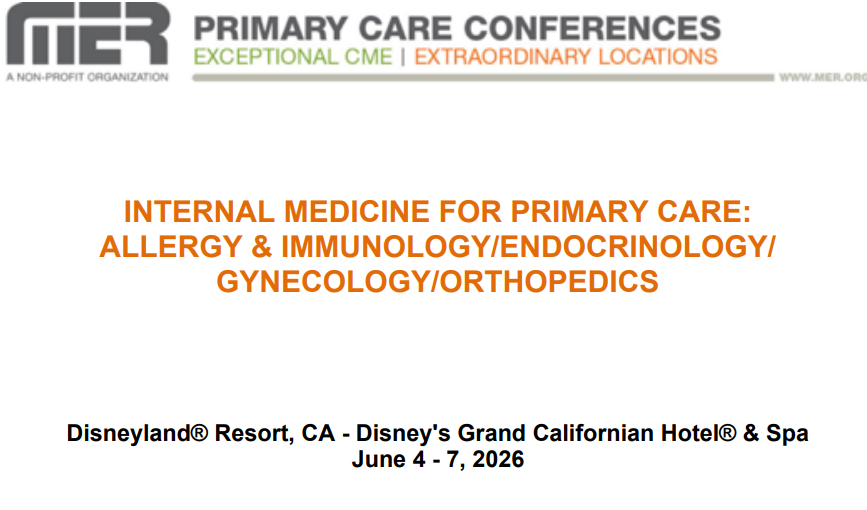
1. Overview The “Internal Medicine for Primary Care: Allergy & Immunology/Endocrinology/Gynecology/Orthopedics” is a conference organized by Medical Education Resources (MER), a non-profit organization. The event is scheduled to take place from June 4-7, 2026, at the Disneyland® Resort, CA – Disney’s Grand Californian Hotel® & Spa.
2. Learning Objectives
Upon completion of this program, participants should be better able to:
-
Diagnose and tailor treatment strategies for type 1 and type 2 diabetes.
-
Identify the risks and benefits of utilizing bisphosphonates in the treatment of osteoporosis.
-
Identify the risks of abnormal thyroid function.
-
Describe treatment options for pituitary disorders.
-
Develop an initial treatment plan for a patient with acute urticaria and/or angioedema.
-
Describe how to efficiently and cost effectively manage patients with asthma, rhinitis, and sinusitis.
-
Outline the management of anaphylactic reactions and indications for immunotherapy.
-
Discuss techniques to improve the health and wellness of the medical provider.
-
Identify evidence-based tools to determine best practices in incorporating all necessary elements in the annual women’s health visit.
-
Assess and manage abnormal uterine bleeding.
-
Describe approaches to counseling patients for making complex contraceptive decisions.
-
Discuss menopausal transition and the risks/benefits of treatment options.
-
Describe the anatomy and function of the knee joint.
-
Diagnose and treat orthopedic problems in the hip, thigh, knee and shoulder.
-
Diagnose and treat shoulder injuries.
-
Diagnose and treat wrist, hand, and finger injuries.
3. Target Audience
This program is targeted to office-based primary care providers and other health professionals with updates in primary care medicine.
4. Topics
Endocrinology
-
Insulin Therapy for Diabetes: Treating T2DM with insulin; T1DM.
-
Osteoporosis: Review the epidemiology and pathophysiology of osteoporosis along with interpretation of DEXA scans and FRAX risk assessment; up-to-date therapeutic options.
-
Disorders of Thyroid Function: Prevalence, diagnosis and treatment options of hypothyroidism and hyperthyroidism.
-
Evaluation and Management of Pituitary Disease: Diagnosis and treatment of pituitary disorders.
Allergy & Immunology
-
Urticaria and Angioedema Updates for Primary Care: This presentation will discuss the pathogenesis and epidemiology of urticaria and angioedema; review the causes of urticaria and angioedema; and discuss the treatment of urticaria and angioedema.
-
Asthma, Allergic Rhinitis, and Sinusitis for Primary Care: Lecture focused on gaining a working knowledge of how to efficiently and cost effectively manage patients with asthma, rhinitis, and sinusitis.
-
Food Allergies and Hymenoptera Allergies: Primary care focused discussion of food and venom allergies including gaining a working knowledge of how to efficiently and cost effectively manage patients with hymenoptera hypersensitivity.
-
Burnout and Clinician Wellness: Strategies that clinicians and healthcare providers can institute with ease to combat the challenges and pitfalls of the current healthcare system.
Gynecology
-
Annual Exam for Women: Best practices in offering annual pelvic examinations in asymptomatic non-pregnant women; Determination of who should be offered a clinical breast exam as a routine part of the annual women’s health exam; The principal elements of the annual women’s health visit: screening, vaccinations, evaluation of health risks and needs, counseling; Evidence-based tools to guide components of the annual women’s health visit based on age and health needs.
-
Abnormal Uterine Bleeding: Overview of normal/abnormal menstrual physiology/profile; Menstrual disturbances; Ovulatory and anovulatory uterine bleeding; Other menstrual abnormalities; Diagnosis and appropriate treatment options.
-
Contraception: A Primary Care Review of Best Practice: Coverage of the effectiveness, side effects and non-contraceptive benefits of available contraceptive options in the U.S.; Discussion of contraceptive counseling that is patient-centric including communicating without coercion; Management strategies for medically complex contraceptive decisions (patients with a history of VTE, breast cancer, hypertension).
-
Menopause Transition and Hormone Replacement Therapy: Symptoms of menopause, including hot flashes, night sweats, and atrophy; Menopause syndromes, including osteoporosis, breast cancer, cardiac disease, and colon cancer; Estrogen analogs; Counseling patients in options and alternatives to hormone therapy; Designer estrogens; SERMS; HRTs; Discussion of risks and benefits, especially in breast cancer and CHD.
Orthopedics
-
The Knee: Anatomy, Common Injuries, and Exam Techniques: ACL, meniscus, MRI; common sports injuries; osteoarthritis and hyaluronan; bursitis: prepatellar, pesanserine; baker’s cyst; joint injection/X-ray interpretation; pediatrics.
-
Hip and Thigh: Emphasizing the tools, physical diagnostic techniques and basic investigations available to the primary care practitioner, a practical approach to the undifferentiated hip problem will be reviewed. Diagnostic triage, historical clues and physical examination pearls pertaining to hip conditions will be covered, and evidence-based management.
-
The Shoulder: Anatomy, Common Injuries, and Exam Techniques: Rotator cuff syndrome; impingement, frozen shoulder; subacromail bursitis; bicipital tendonitis; A-C joint disease.
-
Wrist, Hand, and Fingers: Carpal tunnel, CMC arthritis thumb, ganglion cyst, trigger finger, de Quervains disease.


Reviews
There are no reviews yet.