Description
+ Include: videos + file sub vtt + pdf, size: GB
+ Target Audience: Anesthesiologists, Cardiologists, Pulmonologists, Surgeons, Hospitalists, Intensivists, Nephrologists, Endocrinologists, Infectious Disease Specialists, and Geriatricians
+ Sample video: contact me for sample video
+ Information:
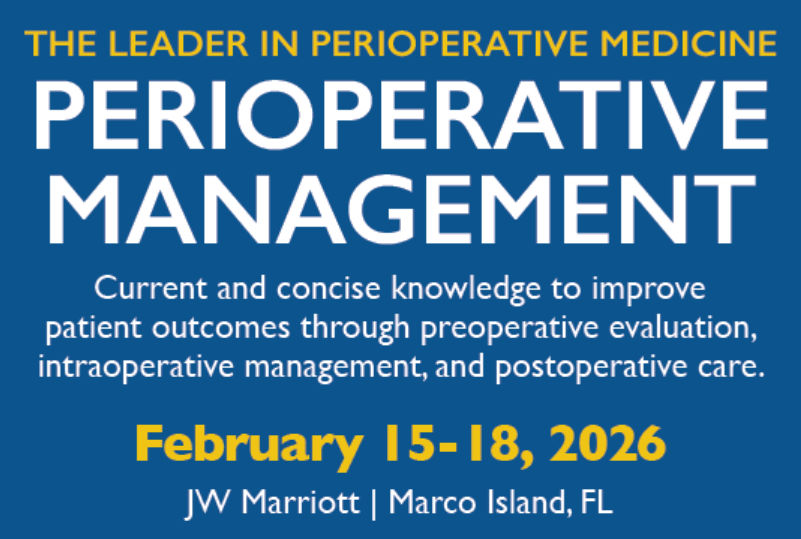
The “Perioperative Management In Its 41st Year” conference is a comprehensive, four-day medical education event scheduled from February 15 to February 18, 2026. This highly anticipated annual program is designed to provide healthcare professionals with the latest evidence-based strategies for managing surgical patients before, during, and after operations. Through a combination of expert-led lectures, interactive panel discussions, and specialized workshops (including Point of Care Ultrasound and Wellness), the conference addresses complex perioperative challenges ranging from cardiopulmonary risk assessments and metabolic management to the integration of Artificial Intelligence and continuous physiological monitoring in modern practice.
Over 300 million patients undergo surgical procedures worldwide, and the age and medical complexity of this patient population continues to increase. Higher risk patients are now having surgery in ambulatory settings. All these patients require preoperative assessment, intraoperative management, and postoperative care. Because the breadth of knowledge in perioperative medicine, which includes the diverse disciplines of surgery, anesthesiology, cardiology, pulmonology, hematology, infectious diseases and geriatrics, is vast, many practitioners may not have uptodate information that is critical to clinical practice. Every year the body of peerreviewed literature on this topic increases and new guidelines on clinical management are formulated. The curriculum for this course was specifically created to address the needs of clinicians who provide care for patients before, during, and after surgery based on examination of the evidence based peer reviewed literature, recent research, feedback from course participants, and input from expert colleagues inside and outside Johns Hopkins. As the established leader in perioperative medicine, this course aims to provide practitioners with the most uptodate knowledge necessary to deliver effective, evidence based care by affecting healthcare practices at the level of the individual and the larger health system.
Learning Objectives
- Describe current guidelines for preoperative cardiac and pulmonary risk assessment and list several ways to predict and prevent cardiac and pulmonary complications using preoperative testing and intraoperative and postoperative interventions.
- Recognize the risks of perioperative anemia and transfusion as well as the risks and benefits of perioperative antithrombotic therapies, and list several strategies to reduce bleeding and thrombotic complications through evidence based approaches to blood management, coagulation testing, and pharmacologic interventions with antithrombotic and antifibrinolytic agents.
- Describe the perioperative complications associated with diabetes, renal insufficiency, liver disease, delirium, and frailty, and list current evidence based management strategies to optimize outcomes in patients with these medical conditions.
- Describe strategies to control acute postoperative pain, including in patients who chronically use opioids or cannabis, using multimodal analgesia and novel nonopioid analgesics.
- Recognize how to prevent, diagnose, and treat common healthcare associated infections that complicate surgical procedures.
- Recognize the perioperative implications of pharmacologic therapies for hypertension, diabetes, obesity, heart failure, and immunomodulators and describe strategies to optimize outcomes through management of these medications perioperatively.
- Recognize the impact of burnout and emotional exhaustion on clinician wellbeing and patient safety, and describe strategies to improve workforce wellbeing and the qualitysafety of clinical care for individual healthcare workers, patients, and the health system.
- Recognize the growing use cases for artificial intelligence in perioperative medicine and its potential to alter clinical practice.
- Recognize basic views for realtime ultrasound guided vascular access and perform vascular access on simulation equipment using ultrasound (optional POCUS Workshop).
- Recognize and interpret basic transthoracic ultrasound views of cardiac and lung structures (optional POCUS Workshop).
- Apply basic ultrasound algorithms to diagnose and manage an unstable perioperative patient (optional POCUS Workshop).
- Recognize and interpret ultrasound views of peripheral nerve structures and how ultrasound can facilitate performance of peripheral nerve blocks for upper and lower extremity surgery (optional POCUS Workshop).
- Recognize the causal role of gratitude in wellbeing (optional Wellness Workshop).
- List several wellbeing improvements associated with awe and wonder interventions (optional Wellness Workshop).
Target Audience
- This conference is designed for a broad spectrum of healthcare professionals involved in the evaluation, management, and care of patients undergoing surgical procedures. This includes physicians, advanced practice providers (NPs and PAs), and trainees who manage patients in preoperative clinics, operating rooms, post-anesthesia care units (PACU), and surgical wards.
- Best for Anesthesiologists, Cardiologists, Pulmonologists, Surgeons, Hospitalists, Intensivists, Nephrologists, Endocrinologists, Infectious Disease Specialists, and Geriatricians.
Topics
Day 1: Sunday, February 15, 2026
-
Introduction and Conference Goals
-
Preoperative Cardiac Risk Assessment and Testing
-
Prevention and Treatment of Perioperative Myocardial Injury
-
Perioperative Management of Patients with Cardiomyopathy
-
Preoperative Evaluation: Optimized, Not Cleared
-
Perioperative Management of Patients on Anti-Platelet Therapy
-
Perioperative Management of Patients on Warfarin and Direct Oral Anticoagulants (DOACs)
-
Preoperative Evaluation and Management of the Patient with Heart Failure
-
Preoperative Management of the Patient with “New ECG Abnormalities”
-
Practical Interpretation and Perioperative Implications of an ECHO Report
-
To Stop or Not to Stop: Managing Immune Modulating Agents and other meds before surgery
-
Resolving Common Perioperative Conundrums: The Role of Point of Care Ultrasound (POCUS)
Day 2: Monday, February 16, 2026
-
Preoperative Pulmonary Risk Assessment and Testing
-
Perioperative Management of the Patient with Pulmonary Hypertension
-
Management of Perioperative Anemia, Transfusion, and Bleeding
-
Burnout and Emotional Exhaustion- Impact on Healthcare Outcomes
-
Improving your Wellbeing and Patient Outcomes through Better Work-Life Integration
-
Perioperative Respiratory Insufficiency: Mechanisms and Management
-
Perioperative Management of the Patient with a Pacemaker or ICD
-
To Cath or Not to Cath: What to do with the Patient with a Positive Postop Troponin
-
Perioperative Hemodynamic Management- Can Goal Directed Therapy and Individualized Targets Improve Outcome?
-
Incidence, Implications, and Management of Postoperative Atrial Fibrillation
-
Challenging Airways: Keeping You and Your Patient Safe
-
“It’s only a sedation case…”: Strategies to Prevent a Cardiopulmonary Catastrophe
-
Acute Hypoxia in the PACU or Ward: Differentiating the Good, the Bad, and the Ugly
-
Optional Workshop: Point of Care Ultrasound (POCUS)
Day 3: Tuesday, February 17, 2026
-
Perioperative Management of Diabetes and Hyperglycemia
-
Perioperative Renal Dysfunction
-
Acute Pain Management: Limiting Narcotics through Multimodal Analgesia
-
Prevention and Treatment of Surgical Site Infections
-
Preventing, Identifying, and Managing Common Healthcare Associated Infections
-
Managing the Pregnant Patient for Obstetrical and Non-Obstetrical Surgery
-
Managing Surgical Patients with Diabetes and Hyperglycemia: Case presentations
-
Perioperative Management of Hyponatremia and Other Electrolyte Abnormalities
-
Perioperative Management of the Patient with Chronic Opioid Use Disorder: Methadone, Buprenorphine, and more
-
What’s New in Pain Management: suzetrigine and cannabis
-
Can we reduce acute kidney injury by improving perioperative hemodynamic management?
-
Perioperative Fluid Management
-
Identifying and Mitigating Perioperative Risks in Patients with Obstructive Sleep Apnea
-
Optional Workshop: Wellness Workshop
Day 4: Wednesday, February 18, 2026
-
Perioperative DVT and Pulmonary Embolism
-
Post-Operative Delirium: Prevention and Treatment
-
Identifying and Managing Risks in Ambulatory Surgery Patients
-
Perioperative Management of Hepatic Dysfunction
-
Improving Perioperative Quality and Safety through System and Culture Change
-
Frailty: Measurement, Prehabilitation, and Periop Management
-
Managing End of Life Care in Surgical Patients
-
ERAS (Enhanced Recovery After Surgery) for Ambulatory Surgery
-
Postoperative Mental Status Changes in Geriatric Patients – Head CT and Call Neurology?
-
Improving the Quality of Sepsis Care
-
Continuous Physiologic Monitoring After the PACU: Which one and for whom?
-
AI in Perioperative Medicine: Hype or Reality?


Reviews
There are no reviews yet.