Description
+ Include: videos + file sub vtt + pdf, size: GB
+ Target Audience: echocardiography physicians, cardiologists
+ Sample video: contact me for sample video
+ Information:
Release Date: April 29, 2026
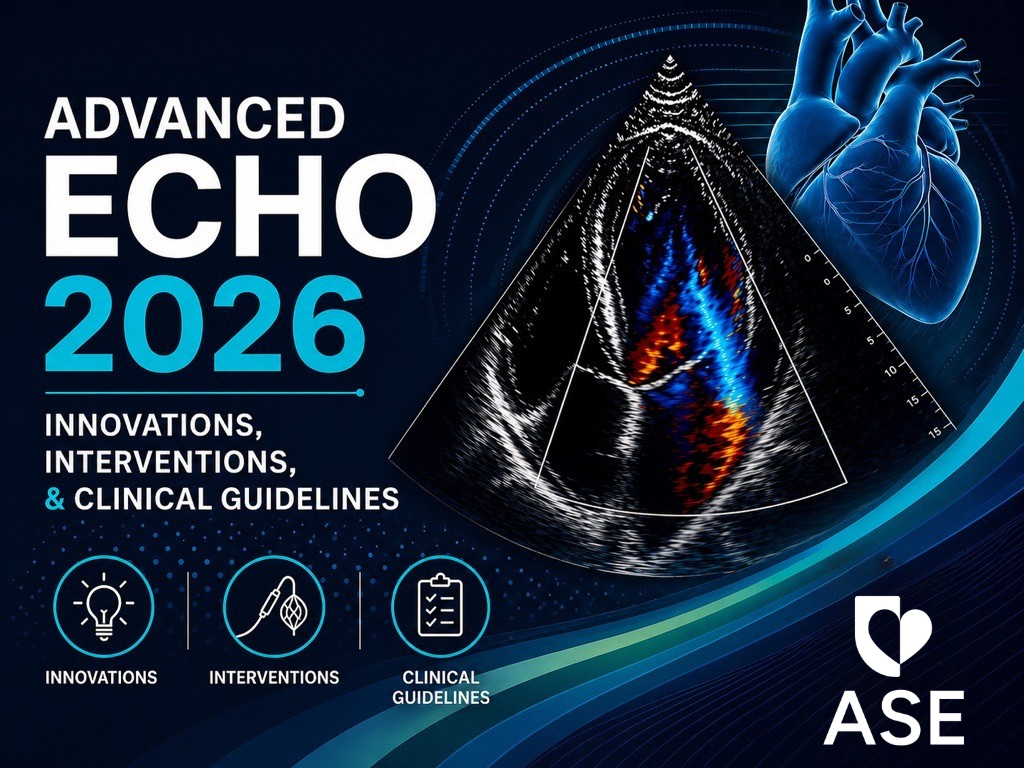
Advanced Echo 2026: Innovations, Interventions, and Clinical Guidelines is a comprehensive program designed to update cardiology and imaging professionals on the forefront of cardiovascular ultrasound. The curriculum comprising of content from the ASE’s State-of-the-Art Echocardiography and Echo Hawaii live courses, explores the latest clinical standards, including the 2025 ASE guidelines for diagnosing HFpEF and approaches for right heart chamber quantification. Case-based approaches are used to discuss new and established applications of echocardiography for diagnosis and guiding management in patients with a broad array of cardiovascular conditions.
Learning Objectives
Upon completion of this program, participants will be better able to:
- Apply recent clinical guidelines to accurately assess right heart chamber quantification, complex diastolic dysfunction, and heart failure with preserved ejection fraction (HFpEF).
- Evaluate complex valvular and structural heart diseases, utilizing procedural echocardiography to confidently guide interventions such as TAVR, Mitral TEER, and Left Atrial Appendage (LAA) occlusion.
- Identify and differentiate specific cardiomyopathies and infiltrative diseases, leveraging modern echo clues to diagnose conditions like amyloidosis in the era of targeted therapy.
- Characterize specialized and congenital cardiac conditions, including uncorrected adult congenital defects, ventricular septal defects, and bicuspid valve aortopathy.
- Integrate cutting-edge echocardiography technologies into daily clinical practice to enhance coronary and structural assessments.
+ Topics:
-
ASE Guideline Right Heart Chamber Quantification
-
Incorporating RV Guidelines into Practice
-
RV PA Coupling & LV PA Coupling
-
RV PA Coupling A Window into Right Heart Performance
-
Ventricular Diastolic Function- Normal Physiology & the Stages of Dysfunction
-
5 Rapid-Fire Cases- Application of the Diastology Guidelines
-
2025 ASE Guideline Approach to Diagnose HFpEF
-
Evaluation of Dilated CM- Ischemic, Postpartum, Infiltrative, Who Recovers..
-
Defining AS Severity- When to be Confident, When to be Cautious
-
Lifetime Management of AS AVR- A Data-Driven Decision..
-
Imaging Following TAVR- What Does Best Practice Look Like..
-
REDO TAVR- What the Future Holds
-
Contemporary Mitral Stenosis- When Calcium Attacks!
-
How Far to Push- Procedural Imaging for Mitral TEER Outside of A2 P2 & Beyond
-
Tricuspid Valve Interventions- Then & Now
-
Prosthetic Valve Function & Dysfunction- Doppler Defined
-
Difficult Doppler Decisions in VHD- The Role of Stress Echo & CMR
-
Deep Dive into Amyloid- Role of Echo & Imaging AL or ATTR..
-
Amyloidosis & Infiltrative Disease- Echo Clues in the Era of Targeted Therapy
-
What to Look for During Surgical Myectomy
-
Identifying & Describing Uncorrected Adult Congenital Defects
-
Ventricular Septal Defects- From Diagnosis to Device Closure
-
Bicuspid Valves and Aortopathy- A Guideline Approach to Imaging & Action
-
Guiding LAA Occlusion- The Interventional Echocardiographer’s Perspective
-
How to Assess the Quantity & Clinical Importance of Pericardial Effusion
-
What Do I Need to Know About Artificial Intelligence..
-
Echoes of Intelligence- How AI is Transforming Cardiac Imaging & Clinical Decision-Making
-
How to Incorporate 3D LV EF into Your Echo Lab
-
Stress, Strain, & Ischemia- Modern Echo Tools for Coronary Assessment
-
Atrial Strain- When & Where Does It Help..



Reviews
There are no reviews yet.