Description
+ Include: videos + file sub vtt + pdf, size: GB
+ Target Audience: Family Physicians, Primary Care Physicians, Internists, Addiction Medicine Specialists, Addiction Psychiatrists, Psychiatrists
+ Sample video: contact me for sample video
+ Information:
-
Course Title: Substance Use Disorders Edition 2
-
Organizer: American Academy of Family Physicians (AAFP)
-
Release Date & Availability: Released March 2024
-
Format: On-Demand Online Course (Video and audio lectures, case studies, downloadable presentation handouts, and clinical reflection session)
-
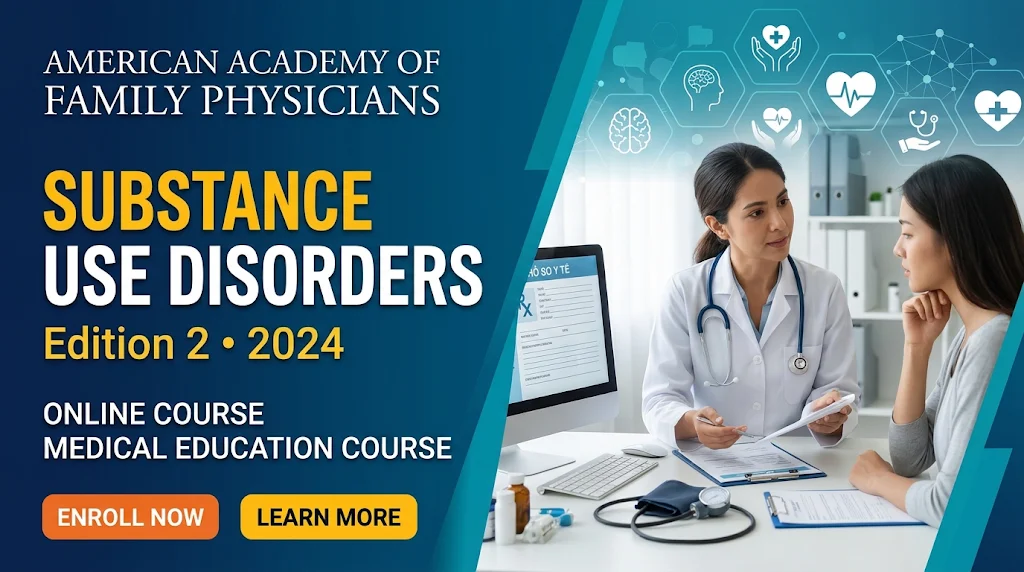
Description: Addiction and substance use are major public health challenges nationwide, and family physicians and primary care professionals play an integral role in identifying, treating, and supporting patients struggling with substance use disorders (SUDs). Leading with a non-stigmatizing, trauma-informed approach to treatment and recovery, Substance Use Disorders Edition 2 equips clinicians with evidence-based diagnostic, pharmacologic, behavioral, and harm-reduction skills. Spanning 18 comprehensive modules, the curriculum covers the neurobiology and lived patient perspective of addiction, motivational interviewing, intake assessment and care coordination, buprenorphine initiation and maintenance for opioid use disorder (OUD), toxicology result interpretation, management of psychiatric comorbidities (sleep, anxiety, depression), stigma and harm reduction, alcohol and stimulant use disorders, smoking cessation and e-cigarettes, drug policy impacts, and emerging psychoactive substances.
Learning Objectives
-
Apply DSM-5-TR criteria for substance use disorder (SUD) diagnosis.
-
Address social determinants of health (SDoH) and co-occurring mental health disorders (such as sleep disturbances, anxiety, and depression).
-
Use motivational interviewing and trauma-informed care principles to foster trust and patient engagement.
-
Address stigma and bias in clinical care and apply practical harm-reduction strategies.
-
Manage the most common substance use disorders seen in primary care—including opioid use disorder (initiation and maintenance of buprenorphine), alcohol use disorder, stimulant use disorder, nicotine/e-cigarette use, and emerging psychoactive substances.
-
Interpret urine and clinical toxicology test results accurately and use them to guide patient-centered interventions.
-
Coordinate multidisciplinary care effectively with behavioral health, social services, and community recovery resources while navigating current drug policies and DEA/MATE Act requirements.
Target Audience
Family physicians, primary care professionals, nurse practitioners, physician assistants, and other DEA-registered clinicians who play an integral part in identifying, treating, and supporting patients struggling with substance use disorders and meeting DEA-mandated MATE Act training requirements.
Best for Family Physicians, Primary Care Physicians, Internists, Addiction Medicine Specialists, Addiction Psychiatrists, Psychiatrists, Behavioral Health Specialists, Pain Management Specialists, Medical Toxicologists, Clinical Pathologists, Pulmonologists, Hepatologists, Gastroenterologists, Infectious Disease Specialists, Public Health and Preventive Medicine Specialists, Emergency Medicine Physicians, Urgent Care Physicians, and Hospitalists.
Topics
-
01. What is Addiction & What is Addiction: Case Studies — Elizabeth Salisbury-Afshar, MD, MPH, FAAFP, DFASAM, FACPM
-
02. Considering the Patient Perspective — Brandon George
-
03. Trauma-Informed Care — David O’Gurek, MD, FAAFP
-
04. Principles of Motivational Interviewing — David O’Gurek, MD, FAAFP
-
05. Evidence Base for Treatment of Opioid Use Disorder (OUD) — Elizabeth Salisbury-Afshar, MD, MPH, FAAFP, DFASAM, FACPM
-
06. Intake Assessment and Care Coordination — David O’Gurek, MD, FAAFP
-
07. Treatment of OUD with Buprenorphine, Part 1: Initiation of Treatment — Nicole Gastala, MD
-
08. Treatment of OUD with Buprenorphine, Part 2: Follow-up Visits and Maintenance — Margaret Lowenstein, MD, MPhil, MSHP
-
09. Interpretation of Toxicology Results — Anika Alvanzo, MD, MS, DFASAM, FACP
-
10. Managing Common Comorbidities: Sleep, Anxiety, Depression — Sky Lee, MD, AAHIVS
-
11. Addressing Harm and Stigma
-
12. Alcohol Use Disorder — Joyce Troxler, MD
-
13. Stimulant Use Disorder: The Tools in Our Mailbox — Hannah Snyder, MD
-
14. Smoking Cessation and E-Cigarettes — Marie-Elizabeth Ramas, MD, FAAFP
-
15. Harm Reduction: Any Positive Change — Elizabeth Salisbury-Afshar, MD, MPH, FAAFP, DFASAM, FACPM
-
16. Drug Policy Impact
-
17. Emerging Psychoactive Substances — Jasleen Salwan, MD, MPH
-
18. Addiction Medicine Reflection Session — Lee Radosh, MD, FAAFP, FASAM


Reviews
There are no reviews yet.