Description
+ Include: videos + file sub vtt + pdf, size: GB
+ Target Audience: Electrophysiologists, Cardiac Electrophysiologists, Pediatric Electrophysiologists, Cardiologists, Interventional Cardiologists
+ Sample video: contact me for sample video
+ Information:
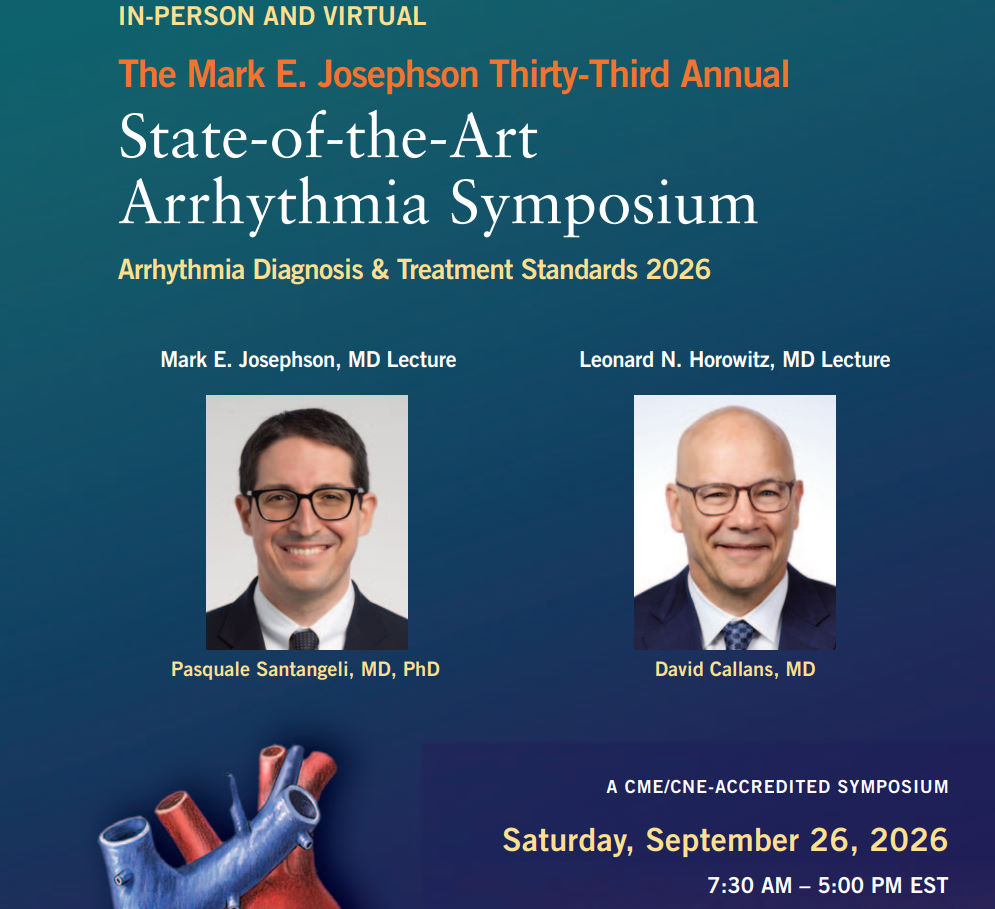
Francis E. Marchlinski, MD, Course Director, invites you to the Thirty-Third Annual State-of-the-Art Arrhythmia Symposium. Using a combination of case presentations with audience participation, didactic presentations, and question and answer sessions, our goal is to educate the participants in state-of-the-art information on invasive and non-invasive electrophysiologic and electrocardiographic tools used in the current diagnosis, evaluation, and treatment of cardiac rhythm disorders. The program is taught by members of the faculty and staff from the University of Pennsylvania Health System, Department of Electrophysiology, in addition to invited speakers from other institutions. This year, we are featuring two keynote speakers for the Leonard N. Horowitz, MD Memorial Lecture and the Mark E. Josephson, MD Lecture given by leaders in cardiology; Pasquale Santangeli, MD, PhD (Professor of Medicine, Associate Section Head and Director of the VT Program, Cleveland Clinic, Cleveland, OH), and David Callans, MD (Professor of Medicine, Co-Director of Electrophysiology, Penn Medicine, Philadelphia, PA).
Learning Objectives
Upon completion of this activity, participants should be better able to:
-
Describe the appropriate evaluation of patients with frequent PVCs and NSVT as well as indications for treatment including ablation and antiarrhythmic medications.
-
Recognize ECG clues to detect patients at risk for serious arrhythmias and sudden death.
-
Apply into practice the newest information regarding evaluation and treatment of atrial arrhythmias including screening for episodes and ablation indications, techniques, and endpoints.
-
Describe the indications for “leadless” pacing and defibrillating devices and optimum implantation techniques.
-
Review the indications, contraindications, and complications associated with left atrial (LA) appendage occlusion and closure.
-
Discuss the methods, techniques, associated tools, and equipment including emerging technologies to perform catheter ablation of atrial fibrillation and flutter.
-
Recognize use and value of new techniques and technologies employed for complex EP devices and ablation cases.
-
Apply into practice the ECG patterns/clinical characteristics, evaluation, and treatment of patients with genetically linked arrhythmia syndromes.
-
Identify the importance of genetic testing and implications regarding results in the treatment of patients with arrhythmias.
-
Review the role of AI in electrophysiology including role in ECG interpretation for VT/SCD risk, ambulatory monitoring, and pre-procedure imaging.
-
Employ the latest advances in device therapy for the treatment of patients with heart failure including cardiac contractility modulation and conduction system pacing.
-
Recognize the use and value of ambulatory monitoring for screening/treating arrhythmias and assessing clinical status.
-
Define the importance of risk factor modification in the treatment of atrial fibrillation and how to achieve goals including the use of GLP1 agonists, effective treatment of high blood pressure and obstructive sleep apnea.
-
Describe appropriate use of anticoagulation for stroke prevention in patients with atrial fibrillation including implications of recent trial data and potential new medications.
-
Interpret how to choose the right patients, use appropriate access and closure techniques, as well as review the tools needed to facilitate same day discharge following ablation and other invasive EP procedures.
Target Audience
The course is structured to meet the educational needs of electrophysiologists, cardiologists, internists, nurses, and associated professionals with an interest in the care of patients with cardiac rhythm disorders. In addition to the morning session with lectures aimed at the entire audience, there are three breakout sessions in the afternoon aimed at 1) associated professionals 2) general cardiology and 3) an advanced electrophysiology session aimed at EP fellows, electrophysiologists, and EP lab staff.
Best for Electrophysiologists, Cardiac Electrophysiologists, Pediatric Electrophysiologists, Cardiologists, Interventional Cardiologists, Heart Failure Specialists, and Medical Geneticists.
+ Topics:
-
AI in Electrophysiology – Ready for Primetime
-
Cardiac Contractility Modulation Therapy for Heart Failure
-
Changing Concepts in Post-MI Ventricular Tachycardia
-
Common Congenital Heart Disease in Adults and Associated Arrhythmias- Pediatric EP Perspective
-
Conduction System Pacing
-
Creating an Atrial Fibrillation Center of Excellence – Addressing the Remaining Challenges and Filling Knowledge-Technology Gaps
-
Debate- Ablation of VT Should be Performed Coincident with ICD Implant
-
Epicardial Mapping and VT Ablation in Patients with an Ischemic Substrate
-
Extravascular ICD Therapy- Highlights of Implantation Techniques in the EP Lab-Prerecorded Case(s)
-
Extravascular ICD Therapy-Case Based Illustrations
-
Highlights from New Guidelines on Antiarrhythmic Drug Use for Atrial Fibrillation in Understudied Situations
-
How Does Radioablation Work– Lessons Learned From the Translational Laboratory
-
How I Approach the Diagnosis of SVT Mechanism- 7 Tips to Remember
-
How to Recognize and Ablate Septal VT Substrate Circuits in NICM
-
How to Target the Most Complex VT Substrates – A Labor of Love
-
Identifying High Risk of Arrhythmia Event Before the Life-Threatening Episode in Nonischemic Syndromes
-
Inherited Arrhythmia and Cardiomyopathy Syndromes
-
Leadless AV Pacing
-
Lessons Learned from Serial MR Imaging in VT Ablation Patients
-
New Access and Closure Techniques and Technology
-
New Insights on Ablation Lesion Formation
-
New Strategies for Mapping and Ablating VT Substrate
-
New Trends in Atrial Fibrillation Risk Factor Modification
-
Nonsustained VT- When to Worry
-
Non-Thermal Pulsed Field Energy for Atrial Fibrillation Ablation
-
Panel Discussion with ARS- Atrial Fibrillation Management Controversies – Have Large Trials Provided a Roadmap for Therapy
-
ParaHisian VT and VPD ablation- Tips and Tricks to Optimize Safety and Efficacy
-
Preparing Your Patient to Get Safely Into and Out of the EP Lab
-
Rapid Fire Cases- New Technology Updates- PFA, Leadless and Extravascular Leads-Devices, Cardioneuroablation, LAAO Panel Discu…
-
Role of Genetic Testing in EP Decision Making
-
Same Day Discharge – Devices, AF Ablation, LAAO
-
Sarcoidosis- Diagnosis, Treatment, Identification of VT Risk and Role-Timing of Ablation
-
Troubleshooting Devices and Monitors
-
Update on Cardioneuroablation
-
Welcome and Introductions
-
What to Do with Low Burden Atrial Fibrillation
-
What’s New in Medical Prevention of Strokes


Reviews
There are no reviews yet.