Description
+ Include: videos + file sub vtt, size: GB
+ Target Audience: Primary Care Physicians, Allergists, Immunologists, Nephrologists, Neurologists, and Pulmonologists
+ Sample video: contact me for sample video
+ Information:
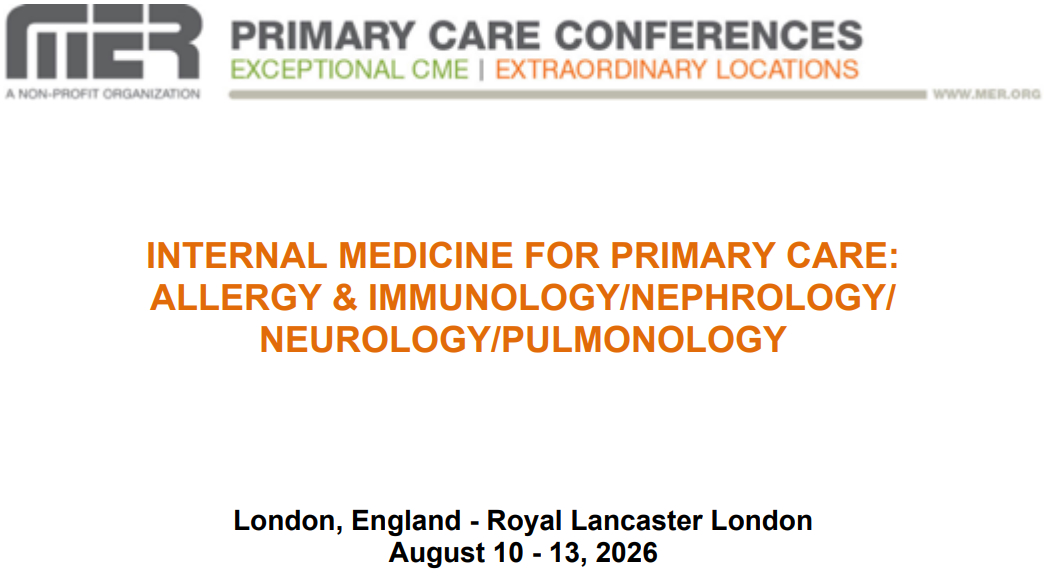
The “Internal Medicine for Primary Care: Allergy & Immunology/Nephrology/Neurology/Pulmonology” conference will be held at the Royal Lancaster London in London, England, from August 10 to August 13, 2026. This live continuing medical education activity is organized by Medical Education Resources (MER) and provides an interprofessional learning experience for the healthcare team.
Learning Objectives
Upon completion of this program, participants should be better able to:
-
Discuss evidence-based management options for Alzheimer’s disease.
-
Evaluate weakness and recognize cardinal features of Parkinson’s disease as well as other movement disorders.
-
Describe the differential diagnosis and treatment options for migraine headaches.
-
Utilize history and physical examination to distinguish weakness from non-specific symptoms.
-
Describe evidence-based guidelines for the use of SGLT2 inhibitors in patients with CKD.
-
Describe treatment options for hematuria and glomerulonephritis.
-
Identify strategies to detect and treat diabetic kidney disease.
-
Review the pathophysiology, diagnosis, prevention and management of common electrolyte imbalances.
-
Diagnose and manage patients with asthma.
-
Design treatment strategies reflective of current evidence-based medicine for common respiratory infections.
-
Describe the current therapeutic management of COPD.
-
Discuss diagnosis and screening strategies as well as treatment plans for lung nodules and lung cancer.
-
Describe how to efficiently and cost effectively manage patients with asthma, rhinitis, and sinusitis.
-
Outline the management of anaphylactic reactions and indications for immunotherapy.
-
Discuss epidemiology, risk factors, and causes of atopic dermatitis.
-
Describe strategies for rediscovering the joy in the practice of medicine.
Target Audience
This program is targeted to office-based primary care providers and other health professionals with updates in primary care medicine.
Best for Primary Care Physicians, Allergists, Immunologists, Nephrologists, Neurologists, and Pulmonologists.
Topics
Monday, August 10, 2026
-
Alzheimer’s & Other Dementias (Neurology): Definition; statistics; neurological changes of normal aging; pathology; etiological theories; vascular dementias; investigations; social issues; symptomatic treatment; research therapies.
-
Parkinson’s Disease & Other Movement Disorders (Neurology): Epidemiology; cardinal features; secondary features; pathology; neurochemistry; differential diagnosis; treatment; complication; other movement disorders; neuroleptic- induced movement disorders; chorea.
-
Headaches & Migraines (Neurology): Basic headache mechanisms; headache history: characteristics, precipitating factors, medical conditions; migraine: common tension, classic, treatment, complicated, cluster, sinus; trigeminal neuralgia; Giant Cell Arteritis; brain tumor; subarachnoid hemorrhage; emergency room treatment.
-
Should All Patients with CKD be on SGLT2 Inhibitors? (Nephrology): Sodium-glucose transporter 2 inhibitors (SGLT2i) represent a major advance in the treatment of patients with diabetes in kidney disease when added onto renin-angiotensin system blocking drugs. Increasing evidence indicates that this class of drugs provides both kidney and cardiovascular benefits to patients with chronic kidney disease, regardless of diabetes status. Primary care providers need to know which patients should be prescribed these drugs as they clearly not only reduce morbidity but also mortality in CKD patients with or without diabetes. This lecture will provide the most up to date use of SGLT2i in patients with CKD, including evidence-based guidelines/goal directed medical therapy.
-
Glomerulonephritis 101 (Nephrology): Glomerulonephritis is an important cause of chronic progressive kidney disease and can be difficult to detect and diagnose. This case based lecture will provide primary care providers with the knowledge and tools on when to suspect glomerulonephritis, how to differentiate from other causes of kidney disease. IgA nephrology, the most common cause of glomerulonephritis, will be discussed as an example of differentiating glomerulonephritides and participants will learn about the mechanisms of action and how to prescribe three FDA approved treatments for patients with this particular glomerular disease.
Tuesday, August 11, 2026
-
Managing Diabetic Kidney Disease: New Insights and Therapies (Nephrology): Chronic kidney disease attributed to diabetes is the leading cause of kidney failure globally. The disease is incurable and kidney disease once established typically progresses and is associated with excessive morbidity and mortality. This presentation will provide up to date information on how to detect, diagnose and manage chronic kidney disease and review recently completed and ongoing clinical trials designed to improve kidney outcomes. The lecture will also discuss when and how to use non-steroidal mineralocorticoid receptor antagonists and Glucagon-like peptide-1 (GLP-1) agonists in clinical practice.
-
Primary Care Primer on Electrolytes (Nephrology): Electrolyte and acid-base disorders are common findings in clinical practice. They can arise from genetic and acquired diseases and can be associated with commonly prescribed medications. This case-based lecture focuses on the disturbances in and interactions between serum sodium, potassium, and bicarbonate. It reviews the pathophysiology, diagnosis and management of these common imbalances.
-
Evaluating Weakness (Neurology): Using the history and physical examination to distinguish weakness from non-specific symptoms; characteristics of neurological diseases that produce weakness; presentations of representative diseases of the nervous system.
-
Asthma (Pulmonology): The medical impact of asthma; fundamental role of inflammation, with possible scarring and irreversible loss of lung function; practical points of diagnosis; goal setting management based on levels of severity; risk factors for mortality and treatment in the acute setting; management options for the difficult to control asthmatic patient.
-
Controversies in the Treatment of Common Respiratory Infections (Pulmonology): Acute and chronic bronchitis; pneumonia (community versus hospital-acquired); role of the Pneumonia Severity Index score in determining indication for hospitalization; cost- effective use of antibiotics; clinical significance of drug resistance; guidelines for management.
Wednesday, August 12, 2026
-
COPD (Pulmonology): Definition; pathophysiology; early detection and intervention; risk reduction; management update including new modalities (including lung volume reduction surgery) and the role of inhaled corticosteroids and domiciliary oxygen.
-
Lung Cancer Screening & Pulmonary Nodules (Pulmonology): Appropriate use of the new lung cancer screening recommendations; Fleischner Society guidelines and American College of Chest Physician Lung Cancer guidelines; approach to definitive evaluation and management strategies.
-
Asthma, Allergic Rhinitis, and Sinusitis for Primary Care (Allergy & Immuno): Lecture focused on gaining a working knowledge of how to efficiently and cost effectively manage patients with asthma, rhinitis, and sinusitis.
-
Food Allergies and Hymenoptera Allergies (Allergy & Immuno): Primary care focused discussion of food and venom allergies including gaining a working knowledge of how to efficiently and cost effectively manage patients with hymenoptera hypersensitivity.
Thursday, August 13, 2026
-
Urticaria, Angioedema, Eczema and Contact Dermatitis (Allergy & Immuno): Lecture focused on gaining a working knowledge of how to efficiently and cost effectively manage patients with various atopic skin conditions.
-
Burnout and Clinician Wellness (Allergy & Immuno): Strategies that clinicians and healthcare providers can institute with ease to combat the challenges and pitfalls of the current healthcare system.



Reviews
There are no reviews yet.