Description
+ Include: videos + file sub vtt, size: GB
+ Target Audience: Primary Care Physicians, Dermatologists, Dietitians, Nutritionists, Bariatric Specialists, and Rheumatologists
+ Sample video: contact me for sample video
+ Information:
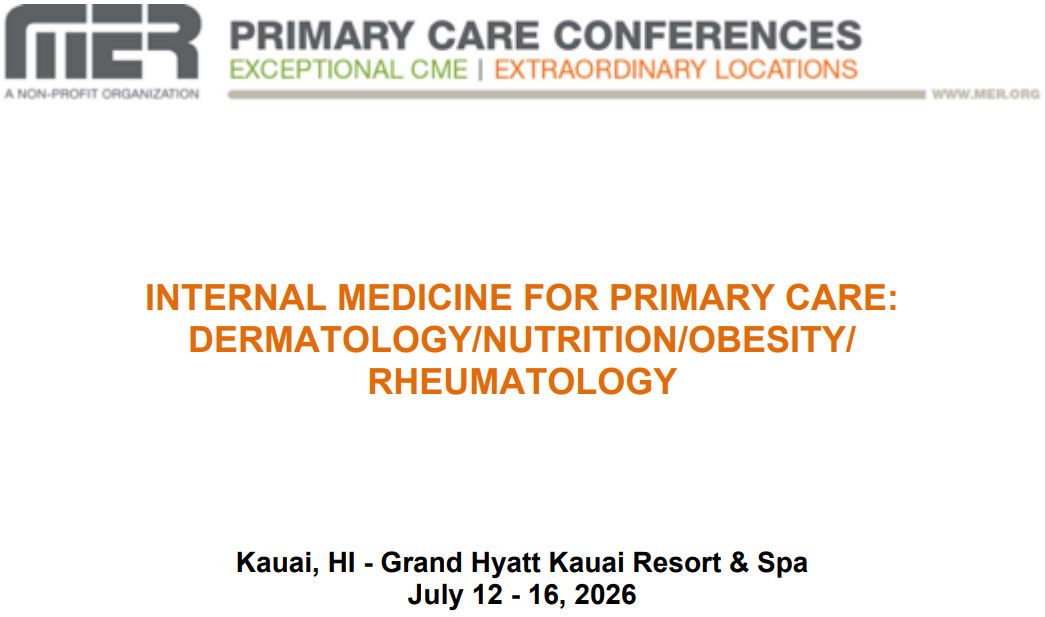
The Internal Medicine for Primary Care: Dermatology/Nutrition/Obesity/Rheumatology conference is a continuing medical education (CME) event organized by Medical Education Resources (MER). Scheduled for July 12-16, 2026, at the Grand Hyatt Kauai Resort & Spa in Kauai, HI, the program provides comprehensive updates and evidence-based strategies to improve patient care across multiple internal medicine disciplines.
Learning Objectives
Upon completion of this program, participants should be better able to:
-
Differentiate between the presentations and causes of atopic, contact (irritant and allergic), and nummular dermatitis.
-
Discriminate the diagnostic principles and treatment options for papulosquamous diseases with red, raised bumps.
-
Describe the step-wise approach for the diagnosis and treatment of acne and acneiform eruptions.
-
Differentiate benign and malignant skin tumors and employ appropriate interoffice procedures.
-
Detect pre-cancerous and cancerous skin lesions.
-
Explain the underlying mechanisms and physiological processes that contribute to the development and progression of obesity, including the roles of genetics, hormones, metabolism, and environmental factors.
-
Discuss non-surgical obesity treatment options.
-
List the advantages and disadvantages of surgical options and the post-surgery care of patients.
-
Describe the approach to patient management after bariatric surgery.
-
Describe the pathophysiology surrounding obesity and council patients on the various weight management strategies, including patient selection criteria for surgery.
-
Discuss how popular diets and nutritional science can lead to healthier lifestyles.
-
Identify expectations for optimal nutrition across the patient’s expected life span.
-
List strategies to modify diet and behaviors in patients with a range of health issues.
-
Describe options for personalizing a patient-specific nutrition plan to each patient.
-
Discuss factors in adequate nutrition that enhance athletic performance.
-
Describe the differential diagnoses of inflammatory arthritis based on clinical presentation and laboratory workup.
-
Review the risks and benefits of the treatment options for arthritis (non-selective NSAIDs, cox-2 inhibitors, DMARDs, narcotics and tramadol).
-
Identify the risks and benefits of utilizing bisphosphonates in the treatment of osteoporosis.
-
Diagnose and treat gout and pseudogout.
-
Utilize current evidence to design treatment strategies for osteoarthritis.
Target Audience
- This program is targeted to office-based primary care providers and other health professionals with updates in primary care medicine.
- Best for Primary Care Physicians, Dermatologists, Dietitians, Nutritionists, Bariatric Specialists, and Rheumatologists.
Topics
-
Dermatology
-
Dermatitis: Overview of the causes and forms of skin irritants; Contact, atopic, irritant, nummular, seborrheic and exfoliative; Treatment of blistering, oozing, crusting and flaking; Diagnostic principles and management strategies.
-
Papulosquamous Diseases: Diagnostic principles of skin lesions consisting of red or purple papules; Psoriasis, lichen planus, pityriasis rosea, lupus erythematosus; Discussion of how to tell one scaly rash from another.
-
Acne and Acneiform Eruptions: Identification of noninflammatory open or closed comedones and inflammatory lesions; Determination of treatment therapies based on acne grading scale; Bacterial folliculitis, drug-induced acne, hidradenitis suppurativa, miliaria, perioral dermatits, pseudofolliculitis barbae, rosacea, seborrheic dermatitis; Topical and systemic therapy.
-
Benign Skin Tumors: Proper diagnosis and treatment of common benign tumors; Biopsies and histopathologic examination; Nevi, seborrheic keratosis keloids, hemangiomas and miscellaneous tumors; When to refer.
-
Premalignant and Malignant Skin Tumors: Recognition of precursors of malignancies; Excisional and punch biopsies; Actinic keratosis, Bowen’s disease, squamous cell carcinoma, basal cell carcinoma, melanoma and other selected tumors; Risk reduction education.
-
-
Obesity
-
Pathophysiology of Obesity: A guide to understanding practice demographics and considerations; The what and why of epigenetics; A practical guide to behavioral and medication management.
-
Medical Management of Obesity: Overview of obesity as a disease state; Costs to the individual of being obese; Use of appetite suppressant medications and lifestyle modifications.
-
Complications and Considerations of Bariatric Surgery: An overview of risks and effectiveness of bariatric surgery; Overview of potential surgical options; Potential complications; The role of support and behavior modification, nutrition, and the stages of patient management post-surgery.
-
Patient Management Post-bariatric Surgery: The role of the clinician for support and behavior modification, nutrition, and the stages of patient management post-surgery.
-
Guiding Patients in the Medical and Surgical Care of Obesity: Differences in treating obesity vs. other medical conditions, treatments, and procedures; Strategies for better engagement and understanding of patient pathways, perspectives, and team partnership.
-
-
Nutrition
-
Myths vs. Science in Nutritional Trends: Approach for the Medical Professional: Discussion of how to scientifically navigate the nutritional maze of popular diets and nutritional trends; The potential nutrition benefits and pitfalls of various dietary preferences and related patient concerns; Ways nutrition affects healthy lifestyles.
-
Nutrition Through the Ages: Prevention and Potential Pitfalls: A working guide for a nutritional and behavioral rubric to understand what is expected (and what may undermine) optimal health from infancy through the elderly; Barriers patients face in implementing and sticking with nutritional strategies.
-
Medical Nutrition Therapy: A Practical Approach to Diet and Disease: Science-based Nutrition and Behavioral Guide to Treating “The Big” Medical Problems that are taking over your practice; Essential (and proven) strategies to help guide patients’ diet and behaviors in the treatment of diabetes, cardiovascular disease, and GI health; Travel through the google-mess of what patients hear and why they turn to these as resources; The science-based strategies and resources that can be implemented to help patients take rational control of their health.
-
Cutting Edge Nutrition Innovation: A Personalized Approach: How to critically evaluate nutrition tools that patients can use to promote optimal health; Review the “latest and greatest” nutrition applications and technologies that can be used to greatly improve patients’ nutrition and health pursuits; Creation of personalized health plans based on unique, patient-specific plans, tests, and analyses.
-
Performance Nutrition: Bridging the Spectrum: Sports nutrition is an evolving field and aims to improve nutrition guidelines for both active adults and competitive athletes; Concepts for how adequate nutrition enhances athletic performance; Discussion of disordered eating and eating disorders; Overview of dietary guidelines and guidance.
-
-
Rheumatology
-
Differential Diagnosis of Inflammatory Arthritis: Clinical presentation and laboratory work-up and treatment for rheumatoid arthritis, systemic lupus erythematosus, spondyloarthropathies (SPA), infectious arthritis and systemic sclerosis; Treatment of RA with DMARDs; Treatment principles of SLE, Sjogren’s, SPA and PMR.
-
Update in Pharmacology for Arthritis: Review risks and benefits of traditional NSAIDs and cox-2 inhibitors; Analgesics (narcotics and tramadol), acetaminophen, conventional-synthetic DMARDs, and bDMARDS.
-
Osteoporosis: Review the epidemiology and pathophysiology of osteoporosis along with interpretation of DEXA scans and FRAX risk assessment; up-to-date therapeutic options.
-
Crystal Disease: Gout & Pseudogout: Properly diagnosing and treating crystal diseases such as gout and pseudogout.
-
Osteoarthritis: Pathogenesis, diagnosis and treatment.
-


Reviews
There are no reviews yet.