Description
+ Include: videos + file sub vtt, size: GB
+ Target Audience: Primary Care Physicians, Geriatricians, Pain Management Specialists, Rheumatologists
+ Sample video: contact me for sample video
+ Information:
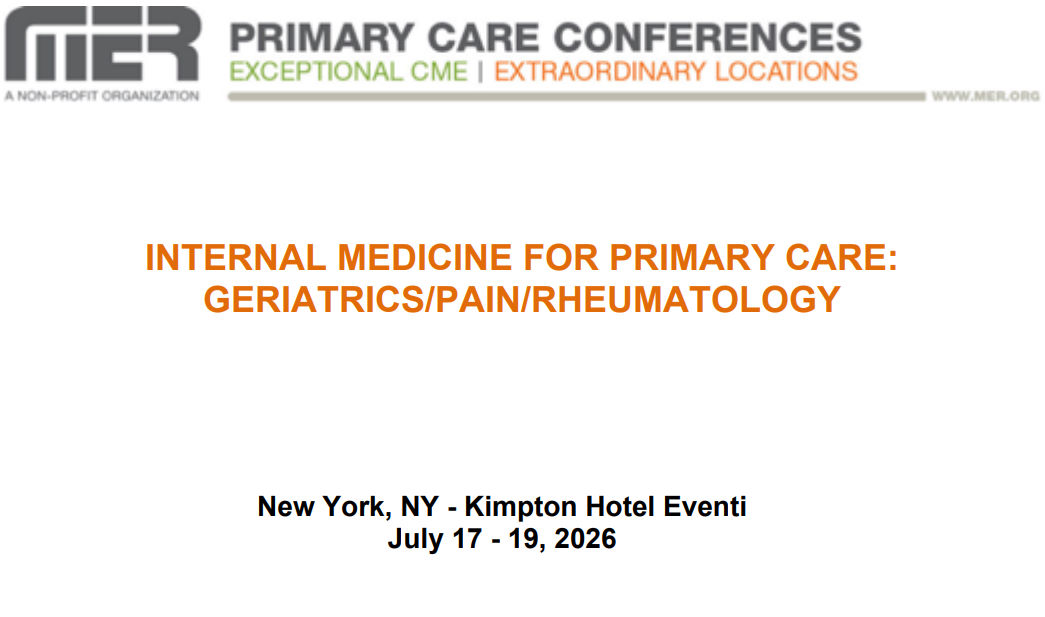
The Internal Medicine for Primary Care: Geriatrics/Pain/Rheumatology conference is an educational event organized by Medical Education Resources (MER), a non-profit organization that provides exceptional continuing medical education (CME). The conference will be held from July 17-19, 2026, at the Kimpton Hotel Eventi in New York, NY.
Learning Objectives
Upon completion of this program, participants should be better able to:
-
Utilize a comprehensive geriatric assessment to identify potential issues in the elderly patient.
-
Describe the assessment and evidence-based treatment plans for heart failure (both reduced and preserved ejection fraction) in collaboration with cardiology.
-
Review common lower urinary tract symptoms (LUTS) that may progress to urinary incontinence, and initiate treatment options.
-
Diagnose and treat cognitive impairment, dementias, and Alzheimer’s disease.
-
Utilize current evidence to design treatment strategies for osteoarthritis.
-
Describe how non-surgical activity modification and physical therapy can benefit low back pain patients.
-
Compare the benefits and side effect profiles of pharmacologic treatment options for fibromyalgia.
-
Design opioid pain management strategies.
-
Describe the differential diagnoses of inflammatory arthritis based on clinical presentation and laboratory workup.
-
Identify the risks and benefits of utilizing bisphosphonates in the treatment of osteoporosis.
-
Diagnose and treat gout and pseudogout.
Target Audience
- This program is targeted to office-based primary care providers and other health professionals with updates in primary care medicine.
- Best for Primary Care Physicians, Geriatricians, Pain Management Specialists, and Rheumatologists.
Topics
-
Geriatrics – Approach to the Geriatric Patient: The demographics of aging and the physiologic changes in the elderly patient; Medication use in the elderly including changes in age-related pharmacokinetics and pharmacodymamics and medication adherence; Review of risky medications often used in elderly patients.
-
Geriatrics – Heart Failure in Older Adults: Recognition of the high mortality associated with heart failure; Understanding how to diagnose heart failure and the difference between reduced ejection fraction and preserved ejection fraction heart failure; Evidence based treatments available for heart failure.
-
Geriatrics – Urological Disorders in the Older Adult: Review of two very common conditions seen in the elderly population: benign prostatic hyperplasia (BPH), and urinary incontinence; Pathogenesis, clinical symptoms, recommended evaluation and management options for BPH; Review of the anatomy and mechanism of normal urinary function, causes of incontinence, the evaluation and management.
-
Pain – Chronic Pain Types and Osteoarthritis: Chronic pain is much more complex than just acute pain that lasts a long time; The physiology and categorization of chronic pain will be explored; Osteoarthritis has characteristics of more than one category of chronic pain; Characteristics that affect treatment planning.
-
Pain – Back Pain: Back pain is a common cause of long term disability; Non-pharmacologic and pharmacologic interventions will be discussed for a variety of causes of back pain including failed back surgery syndrome.
-
Pain – Fibromyalgia and Cannabinoids for Chronic Pain: Fibromyalgia is a classic example of the nociplastic chronic pain category; A variety of treatment modalities will be discussed; In addition, the evidence regarding the use of cannabinoids for chronic pain will be presented.
-
Pain – Safe Opioid Prescribing: The role of opioids in the management of chronic pain will be addressed in the contexts of the updated CDC guidelines and the increasing prevalence of opioid use disorder.
-
Geriatrics – Alzheimer’s & Other Dementias: Review of normal age-related changes in cognitive function as well as disorders of memory and cognition as part of dementing illness; Mental status exams, including their limitations in evaluating memory; Various types of dementia and the importance of an accurate diagnosis; Current treatment options for various kinds of dementia; Potentially reversible dementias; The responsibilities of healthcare providers in managing patients with dementia.
-
Rheumatology – Osteoarthritis: Pathogenesis, diagnosis and treatment.
-
Rheumatology – Differential Diagnosis of Inflammatory Arthritis: Clinical presentation and laboratory work-up and treatment for rheumatoid arthritis, systemic lupus erythematosus, spondyloarthropathies (SPA), infectious arthritis and systemic sclerosis; Treatment of RA with DMARDs; Treatment principles of SLE, Sjogren’s, SPA and PMR.
-
Rheumatology – Osteoporosis: Review the epidemiology and pathophysiology of osteoporosis along with interpretation of DEXA scans and FRAX risk assessment; up-to-date therapeutic options.
-
Rheumatology – Crystal Disease: Gout & Pseudogout: Properly diagnosing and treating crystal diseases such as gout and pseudogout.


Reviews
There are no reviews yet.