Description
+ Include: videos + file sub vtt, size: GB
+ Target Audience: Primary Care Physicians, Cardiologists, Pulmonologists, Endocrinologists
+ Sample video: contact me for sample video
+ Information:
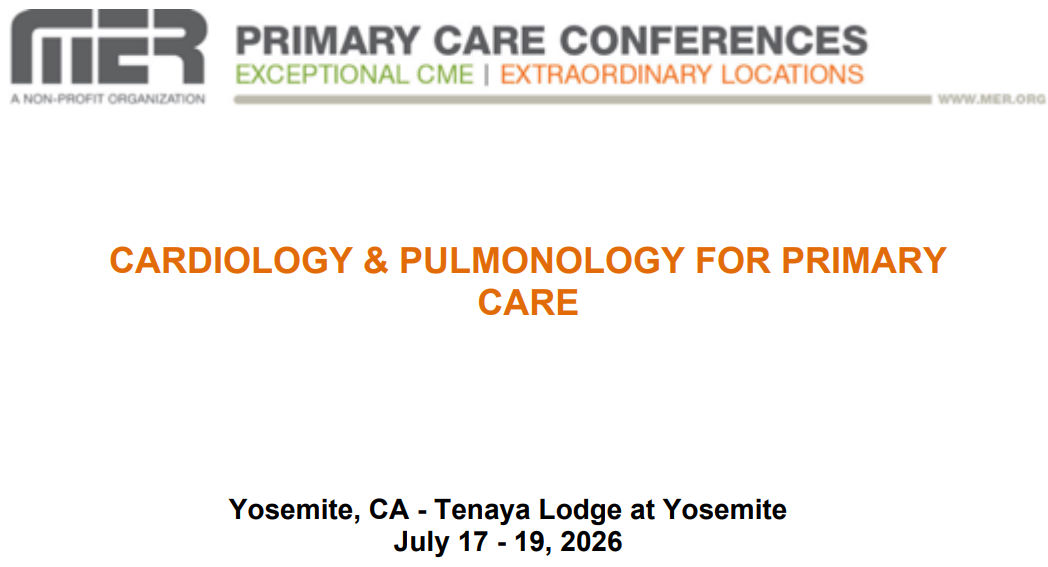
The Cardiology & Pulmonology for Primary Care conference is organized by Medical Education Resources (MER). It is scheduled to take place from July 17-19, 2026, at the Tenaya Lodge at Yosemite in Yosemite, CA
Learning Objectives
Upon completion of this program, participants should be better able to:
-
Describe the work-up, risk assessment and test selection of patients with suspected CAD.
-
Discuss best practices for reading and interpreting EKGs.
-
Describe current diagnostic approaches and the role of drug therapy to the patient with acute chest pain.
-
Implement lifestyle changes as well as lipid and cholesterol guidelines for the prevention of CAD.
-
Diagnose and manage patients with asthma.
-
Design treatment strategies reflective of current evidence-based medicine for common respiratory infections.
-
Describe the current therapeutic management of COPD.
-
Discuss diagnosis and screening strategies as well as treatment plans for lung nodules and lung cancer.
-
Implement treatment strategies reflective of recent guidelines and current evidence based medicine for heart failure.
-
Explain current concepts in the diagnosis and treatment of hypertension.
-
Identify and treat cardiovascular complications associated with T2DM.
-
Discuss cardiovascular complications associated with obesity.
Target Audience
- This program is targeted to office-based primary care providers and other health professionals with updates in primary care medicine. Best for Primary Care Physicians, Cardiologists, Pulmonologists, and Endocrinologists.
Topics
Cardiology
-
Work-up of Patients with Suspected CAD: Risk factor evaluation and risk assessment models; 2021 ACC/AHA Chest Pain Guidelines; Test selection including ECG, echo, nuclear and newer imaging modalities (including discussion of appropriate use criteria–AUC); The usefulness of CT scanning; The role of bio markers and EBCT; Suspected CAD in special populations (women, diabetics, the elderly).
-
EKG and Clinical Correlation for Primary Care: A case-based refresher including challenging EKG readings.
-
Acute Coronary Syndromes: The Patient with Acute Chest Pain: Diagnosis and initial evaluation in the primary care setting, urgent care clinic and emergency department; Initial workup, treatment, and follow-up; Diagnosing and treating ST segment elevation and non-ST segment elevation MIs; The role of drug therapy–primary vs adjunctive to PCI; Follow up after acute coronary syndromome.
-
Primary Prevention of Cardiometabolic CVD: Definitions; AHA/ACC and other lipid guidelines updates; HDL Cholesterol: The good cholesterol?; Metabolic syndrome and/or obesity; Who needs treatment and how much; The role of lifestyle changes, exercise and cardiac rehabilitation; Drug therapy updates; Risk calculation; Role of pooled equations for risk estimates.
-
Heart Failure: Etiologies and stages of heart failure; ACC/AHA Heart Failure Guidelines; Heart failure with reduced EF (HFrEF) and heart failure with preserved EF (HFpEF); Determining patients for referral using biomarkers, eg NT Pro BNP; Treatment options: ACE inhibitors, ARBS, ARNI, beta blockers, mineralocorticoid receptor antagonists, SGLT2i; The role of devices (ICD and/or CRT) in treatment and antiplatelet drugs; Issues related to the hospitalized patient with acute decompensated heart failure and readmissions.
-
Hypertension: The 2025 AHA/ACC Hypertension Guidelines; The 2024 ESC Guidelines for hypertension; Approaches to treatment thresholds and goals; Choices for initial and combination therapy; Resistant hypertension; Treating special populations: diabetics, the elderly, patients with renal failure; Risk factors by new pooled equations.
-
Type 2 Diabetes and Cardiovascular Disease: Epidemiology of risk for cardiovascular complications associated with type 2 diabetes; Review of the accumulated data with regard to the cardiovascular safety and efficacy of newer antihyperglycemic medications; Overview of most recent endocrinology and cardiology society recommendations and guidelines for their use.
-
Obesity and Cardiovascular Disease: Epidemiology of risk for cardiovascular complications associated with being overweight and obesity; Review the accumulated data with regard to the cardiovascular safety; Efficacy of medications approved or in development for the treatment of obesity.
Pulmonology
-
Asthma: The medical impact of asthma; fundamental role of inflammation, with possible scarring and irreversible loss of lung function; practical points of diagnosis; goal setting management based on levels of severity; risk factors for mortality and treatment in the acute setting; management options for the difficult to control asthmatic patient.
-
Controversies in the Treatment of Common Respiratory Infections: Acute and chronic bronchitis; pneumonia (community versus hospital-acquired); role of the Pneumonia Severity Index score in determining indication for hospitalization; cost- effective use of antibiotics; clinical significance of drug resistance; guidelines for management.
-
COPD: Definition; pathophysiology; early detection and intervention; risk reduction; management update including new modalities (including lung volume reduction surgery) and the role of inhaled corticosteroids and domiciliary oxygen.
-
Lung Cancer Screening & Pulmonary Nodules: Appropriate use of the new lung cancer screening recommendations; Fleischner Society guidelines and American College of Chest Physician Lung Cancer guidelines; approach to definitive evaluation and management strategies.


Reviews
There are no reviews yet.