Description
+ Include: videos + file sub vtt, size: GB
+ Target Audience: Primary Care Physicians, Cardiologists, Psychiatrists, Addiction Medicine Specialists
+ Sample video: contact me for sample video
+ Information:
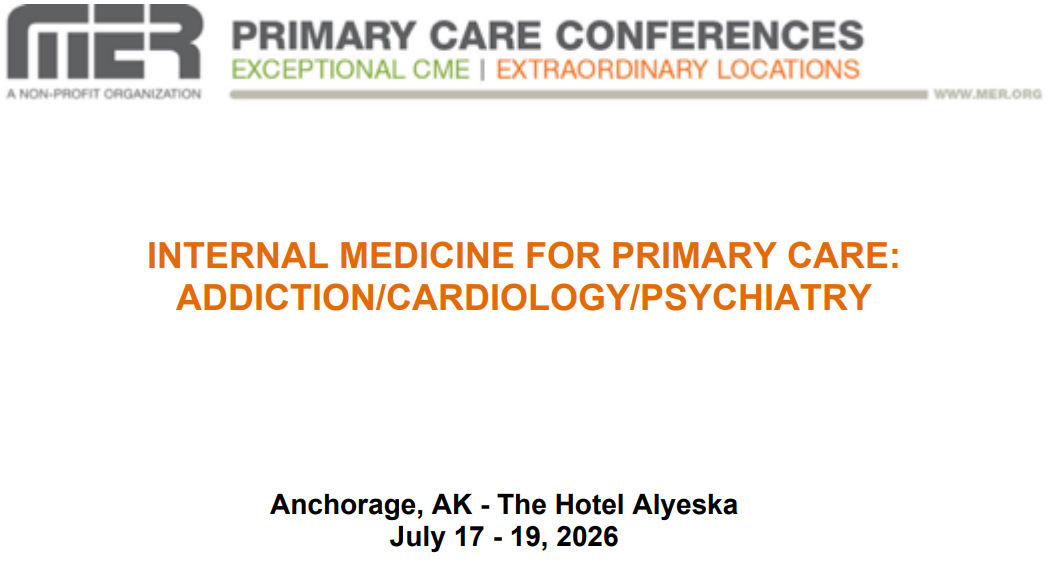
The “Internal Medicine for Primary Care: Addiction/Cardiology/Psychiatry” conference is a continuing medical education event hosted by Medical Education Resources (MER), a non-profit organization. The conference will take place from July 17-19, 2026, at The Hotel Alyeska in Anchorage, AK.
Learning Objectives
Upon completion of this program, participants should be better able to:
-
Describe current diagnostic approaches and the role of drug therapy to the patient with acute chest pain.
-
Implement treatment strategies reflective of recent guidelines and current evidence based medicine for heart failure.
-
Describe current diagnostic and treatment approaches to arrhythmias and atrial fibrilation.
-
Explain current concepts in the diagnosis and treatment of hypertension.
-
Compare the benefits and side effect profiles of pharmacologic treatment options for ADHD.
-
Discuss mood stabilizing psychosocial and pharmacologic treatments of bipolar disorder as well as frequent co-morbid psychiatric disorders.
-
Assess patients at risk for suicide and violence and intervene to make timely referrals to combat hopelessness.
-
Recommend appropriate pharmacologic and non-pharmacologic treatment for depression.
-
Describe strategies for identifying and treating substance use disorders.
-
Review the effects of addictive drugs including hallucinogens, stimulants, inhalants, sedatives, tobacco and alcohol.
-
Identify therapies, including nonpharmacological pain treatment strategies, that can reduce the dose of opioids to control pain.
-
Develop a treatment plan for Alcohol Use Disorder.
Target Audience
- This program is targeted to office-based primary care providers and other health professionals with updates in primary care medicine. Best for Primary Care Physicians, Cardiologists, Psychiatrists, and Addiction Medicine Specialists.
Topics
-
Acute Coronary Syndromes: The Patient with Acute Chest Pain: Diagnosis and initial evaluation in the primary care setting, urgent care clinic and emergency department; Initial workup, treatment, and follow-up; Diagnosing and treating ST segment elevation and non-ST segment elevation MIs; The role of drug therapy–primary vs adjunctive to PCI; Follow up after acute coronary syndromome.
-
Heart Failure: Etiologies and stages of heart failure; ACC/AHA Heart Failure Guidelines; Heart failure with reduced EF (HFrEF) and heart failure with preserved EF (HFpEF); Determining patients for referral using biomarkers, eg NT Pro BNP; Treatment options: ACE inhibitors, ARBs, ARNI, beta blockers, mineralocorticoid receptor antagonists, SGLT2i; The role of devices (ICD and/or CRT) in treatment and antiplatelet drugs; Issues related to the hospitalized patient with acute decompensated heart failure and readmissions.
-
Arrhythmias: Types and symptoms of arrhythmias; Approach to the patient: when to treat, when to refer, when to admit; Evaluation of the patient with palpitations; Atrial fibrilation: the use of anticoagulants indications, CVA risk scores, warfarin vs newer oral anticoagulants, controlling heart rate vs rhythm; Ventricular and other arrhythmias: when are they serious.
-
The Complexity of Adult ADHD: ADHD in adults with an emphasis on symptom identification; Co-occurring conditions; Psychiatric and medical differential diagnosis; evidence-based and FDA approved pharmacological treatments.
-
Bipolar Spectrum Disorders: Bipolar spectrum disorders in adults as compared to youth; Comprehensive history-taking; Differential diagnosis; Co-occurring psychiatric and medical conditions; Phase specific treatment considerations and interventions.
-
Suicide and Violence: Risk assessment for suicide and violence; the relationship between psychotropic medications and suicide or violent behavior; management of the suicidal and violent patient.
-
Depressive Disorders: History taking, diagnosis and treatment of depression across the lifespan; pharmacologic and non-pharmacologic treatment options; rational polypharmacy.
-
Hypertension: The 2025 AHA/ACC Hypertension Guidelines; The 2024 ESC Guidelines for hypertension; Approaches to treatment thresholds and goals; Choices for initial and combination therapy; Resistant hypertension; Treating special populations: diabetics, the elderly, patients with renal failure; Risk factors by new pooled equations.
-
Substance Use Disorders: Diagnosis and Screening for Primary Care Practitioners: Essential information and skills necessary for identifying substance use and addiction in the primary care setting; Epidemiology, assessment and screening tools; Practical steps for intervention.
-
Drugs: Review of Addictive Drugs and Their Effects: This module will review hallucinogens, stimulants, inhalants, sedatives, tobacco and alcohol.
-
The Opioid Crisis and Primary Care Providers: Update on the opioid crisis; Risk for opioid misuse and addiction; FDA approved medication for treating overdose; FDA approved medication-assisted treatment (MAT) for managing opioid addiction.
-
Treatment of Alcohol Use Disorder in Primary Care: The scope of alcohol related problems and the societal burden of Alcohol Use Disorder; Overview of FDA-approved and more common off-label pharmacotherapies for Alcohol Use Disorder.


Reviews
There are no reviews yet.