Description
+ Include: videos + file sub vtt, size: GB
+ Target Audience: internists, primary care physicians, dermatologists, gynecologists, radiologists, and rheumatologists
+ Sample video: contact me for sample video
+ Information:
1. Overview
-
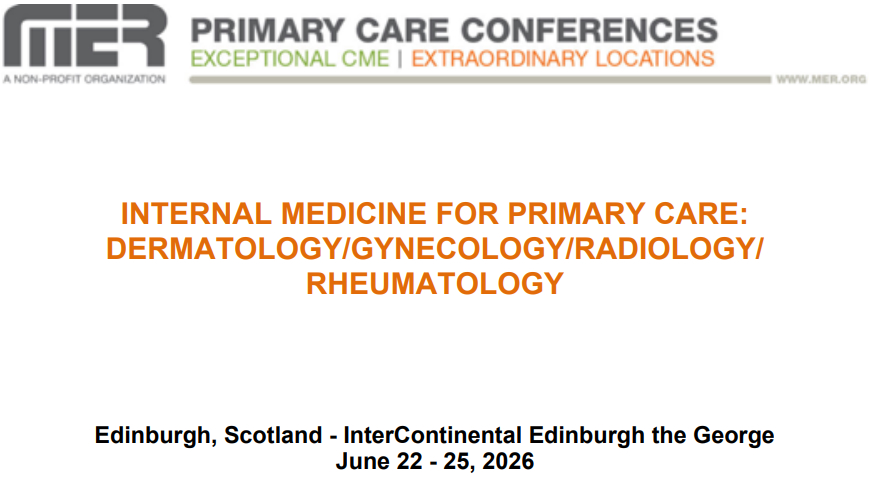
Conference Name: Internal Medicine for Primary Care: Dermatology/Gynecology/Radiology/Rheumatology.
-
Organizer: Medical Education Resources (MER), a non-profit organization.
-
Date: June 22-25, 2026.
-
Location: InterContinental Edinburgh the George, Edinburgh, Scotland.
2. Learning Objectives
Upon completion of this program, participants should be better able to:
-
Differentiate between the presentations and causes of atopic, contact (irritant and allergic), and nummular dermatitis.
-
Differentiate benign and malignant skin tumors and employ appropriate interoffice procedures.
-
Detect pre-cancerous and cancerous skin lesions.
-
Describe the step-wise approach for the diagnosis and treatment of acne and acneiform eruptions.
-
Review the risks and benefits of the treatment options for arthritis (non-selective NSAIDs, cox-2 inhibitors, DMARDs, narcotics and tramadol).
-
Utilize current evidence to design treatment strategies for osteoarthritis.
-
Describe the differential diagnoses of inflammatory arthritis based on clinical presentation and laboratory workup.
-
Diagnose and treat gout and pseudogout.
-
Identify evidence-based tools to determine best practices in incorporating all necessary elements in the annual women’s health visit.
-
Assess and manage abnormal uterine bleeding.
-
Describe approaches to counseling patients for making complex contraceptive decisions.
-
Discuss menopausal transition and the risks/benefits of treatment options.
-
Describe recent advances in ultrasound technology and rationale for ordering radiologic tests.
-
Discuss current guidelines for using ultrasound in the management of thyroid nodules.
-
Utilize imaging in the management of abdominal pathologies.
-
Manage incidental findings on imaging tests.
3. Target Audience
This program is targeted to office-based primary care providers and other health professionals with updates in primary care medicine. Best for internists, primary care physicians, dermatologists, gynecologists, radiologists, and rheumatologists.
4. Topics
Dermatology
-
Dermatitis: Overview of the causes and forms of skin irritants; Contact, atopic, irritant, nummular, seborrheic and exfoliative; Treatment of blistering, oozing, crusting and flaking; Dagnostic principles and management strategies.
-
Benign Skin Tumors: Proper diagnosis and treatment of common benign tumors; Biopsies and histopathologic examination; Nevi, seborrheic keratosis keloids, hemangiomas and miscellaneous tumors; When to refer.
-
Premalignant and Malignant Skin Tumors: Recognition of precursors of malignancies; Excisional and punch biopsies; Actinic keratosis, Bowen’s disease, squamous cell carcinoma, basal cell carcinoma, melanoma and other selected tumors; Risk reduction education.
-
Acne and Acneiform Eruptions: Identification of noninflammatory open or closed comedones and inflammatory lesions; Determination of treatment therapies based on acne grading scale; Bacterial folliculitis, drug-induced acne, hidradenitis suppurativa, miliaria, perioral dermatits, pseudofolliculitis barbae, rosacea, seborrheic dermatitis; Topical and systemic therapy.
Rheumatology
-
Update in Pharmacology for Arthritis: Review risks and benefits of traditional NSAIDs and cox-2 inhibitors; Analgesics (narcotics and tramadol), acetaminophen, conventional-synthetic DMARDs, and bDMARDs.
-
Osteoarthritis: Pathogenesis, diagnosis and treatment.
-
Differential Diagnosis of Inflammatory Arthritis: Clinical presentation and laboratory work-up and treatment for rheumatoid arthritis, systemic lupus erythematosus, spondyloarthropathies (SPA), infectious arthritis and systemic sclerosis; Treatment of RA with DMARDs; Treatment principles of SLE, Sjogren’s, SPA and PMR.
-
Crystal Disease: Gout & Pseudogout: Properly diagnosing and treating crystal diseases such as gout and pseudogout.
Gynecology
-
Annual Exam for Women: Best practices in offering annual pelvic examinations in asymptomatic non-pregnant women; Determination of who should be offered a clinical breast exam as a routine part of the annual women’s health exam; The principal elements of the annual women’s health visit: screening, vaccinations, evaluation of health risks and needs, counseling; Evidence-based tools to guide components of the annual women’s health visit based on age and health needs.
-
Abnormal Uterine Bleeding: Overview of normal/abnormal menstrual physiology/profile; Menstrual disturbances; Ovulatory and anovulatory uterine bleeding; Other menstrual abnormalities; Diagnosis and appropriate treatment options.
-
Contraception: A Primary Care Review of Best Practice: Coverage of the effectiveness, side effects and non-contraceptive benefits of available contraceptive options in the U.S.; Discussion of contraceptive counseling that is patient-centric including communicating without coercion; Management strategies for medically complex contraceptive decisions (patients with a history of VTE, breast cancer, hypertension).
-
Menopause Transition and Hormone Replacement Therapy: Symptoms of menopause, including hot flashes, night sweats, and atrophy; Menopause syndromes, including osteoporosis, breast cancer, cardiac disease, and colon cancer; Estrogen analogs; Counseling patients in options and alternatives to hormone therapy; Designer estrogens; SERMS; HRTs; Discussion of risks and benefits, especially in breast cancer and CHD.
Radiology
-
Appropriate Ordering of Imaging and Contrast: Guidelines to assist referring providers in ordering the most appropriate and effective imaging studies for routine and acute presentations; Special emphasis given to when to use contrast agents.
-
Ultrasound of the Thyroid and Superficial Soft Tissue Masses: Review of benign and concerning features of thyroid nodules, as well as management recommendations according to current guidelines and supportive evidence; Discussion of the role of ultrasound in the evaluation of common superficial soft tissue masses (lumps and bumps); Management recommendations.
-
Imaging of the Acute Abdomen: Primary care focused discussion of the role of imaging and special considerations for imaging in the diagnosis and management of both common and uncommon acute abdominal pathologies.
-
Managing Common Incidental Findings: Discussion of common incidental findings in radiology; Review of management guidelines according to the American College of Radiology (ACR) and other medical and surgical societies.


Reviews
There are no reviews yet.