Description
+ Include: videos + file sub vtt, size: GB
+ Target Audience: primary care physicians, internists, family physicians, geriatric physicians, addiction medicine physicians, gynecologists, vascular medicine physicians
+ Sample video: contact me for sample video
+ Information:
1. Overview
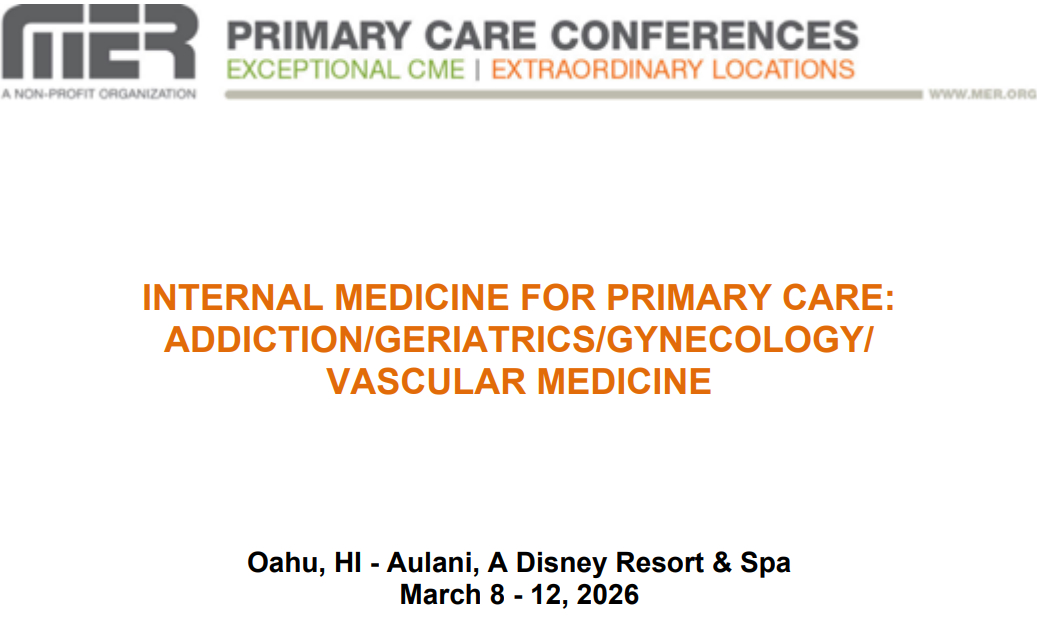
The “Internal Medicine for Primary Care: Addiction/Geriatrics/Gynecology/Vascular Medicine” is a continuing medical education conference organized by Medical Education Resources (MER), a non-profit organization. The event is scheduled to take place from March 8-12, 2026, at Aulani, A Disney Resort & Spa in Oahu, Hawaii.
2. Learning Objectives
Upon completion of this program, participants should be better able to:
-
Describe strategies for identifying and treating substance use disorders.
-
Review the effects of addictive drugs including hallucinogens, stimulants, inhalants, sedatives, tobacco and alcohol.
-
Identify therapies, including nonpharmacological pain treatment strategies, that can reduce the dose of opioids to control pain.
-
Develop a treatment plan for Alcohol Use Disorder.
-
Utilize case-based learning to develop treatment plans for substance use disorders.
-
Review common lower urinary tract symptoms (LUTS) that may progress to urinary incontinence, and initiate treatment options.
-
Describe the assessment and evidence-based treatment plans for heart failure (both reduced and preserved ejection fraction) in collaboration with cardiology.
-
Utilize discussion and case-based learning to further incorporate treatment options for heart failure into practice.
-
Evaluate hypertension in both younger and older adults, differentiate risks and goals of treatment, and recommend appropriate interventions.
-
Utilize discussion and case-based learning to further incorporate treatment options for hypertension into practice.
-
Assess and manage abnormal uterine bleeding.
-
Describe the management of abnormal pap smears and HPV.
-
Discuss menopausal transition and the risks/benefits of treatment options.
-
Describe approaches to counseling patients for making complex contraceptive decisions.
-
Discuss the current evidence and recommendations regarding breast cancer screening.
-
Describe the spectrum of maladies included in peripheral vascular disease.
-
Discuss presentation and interventional treatment of stroke patients.
-
List current pharmacologic options for the management of aneurysms.
-
Describe the evaluation and treatment of venous thrombosis.
-
Discuss presentation and interventional treatment of swelling and ulcers of dysvascular limbs.
3. Target Audience
This program is targeted to office-based primary care providers and other health professionals with updates in primary care medicine.
4. Topics
Here is the full and detailed list of topics covered during the conference:
Addiction:
-
Substance Use Disorders: Diagnosis and Screening for Primary Care Practitioners: Essential information and skills necessary for identifying substance use and addiction in the primary care setting; Epidemiology, assessment and screening tools; Practical steps for intervention.
-
Drugs: Review of Addictive Drugs and Their Effects: This module will review hallucinogens, stimulants, inhalants, sedatives, tobacco and alcohol.
-
The Opioid Crisis and Primary Care Providers: Update on the opioid crisis; Risk for opioid misuse and addiction; FDA approved medication for treating overdose; FDA approved medication-assisted treatment (MAT) for managing opioid addiction.
-
Treatment of Alcohol Use Disorder in Primary Care: The scope of alcohol related problems and the societal burden of Alcohol Use Disorder; Overview of FDA-approved and more common off-label pharmacotherapies for Alcohol Use Disorder.
-
Addiction Medicine Cases: Challenging case presentations in addiction medicine.
Geriatrics:
-
Urological Disorders in the Older Adult: Review common lower urinary tract symptoms (LUTS) in older adults that may progress to incontinence; Practical approaches to differential diagnoses and management of Stress Incontinence, Overflow Incontinence, and Overactive Bladder (OAB), leading to Urge Incontinence.
-
Heart Failure in Older Adults: Recognition of the high mortality associated with heart failure; Understanding how to diagnose heart failure and the difference between reduced ejection fraction and preserved ejection fraction heart failure; Evidence based treatments available for heart failure.
-
Heart Failure Discussion and Q&A: Interactive review of the principles of heart failure diagnosis and treatment in older adults, and audience questions further clarifying the topic.
-
Controversies in the Management of Hypertension in Older Adults: Best evidence for treatment goals for hypertension in diabetics and those with previous stroke; Controversial evidence for the various guidelines for diagnosing and treating hypertension in older adults; Best evidence-based medications for hypertension.
-
Hypertension Discussion and Q&A: Interactive review of the principles of hypertension diagnosis and treatment in older adults, and audience questions further clarifying the topic.
Gynecology:
-
Abnormal Uterine Bleeding: Overview of normal/abnormal menstrual physiology/profile; Menstrual disturbances; Ovulatory and anovulatory uterine bleeding; Other menstrual abnormalities; Diagnosis and appropriate treatment options.
-
Abnormal Pap Smears and High Risk HPV: Current recommendations for cervical cancer screening; Incorporating the ASCCP consensus guidelines for management of cytologic cervical abnormalities (including ASCUS, LGSIL, HGSIL and atypical glandular cells) into your practice; Algorithm for the appropriate use of HPV testing; History of HPV and effectiveness of its use; Recommendations for missed doses; Storage and administration of HPV vaccines.
-
Menopause Transition and Hormone Replacement Therapy: Symptoms of menopause, including hot flashes, night sweats, and atrophy; Menopause syndromes, including osteoporosis, breast cancer, cardiac disease, and colon cancer; Estrogen analogs; Counseling patients in options and alternatives to hormone therapy; Designer estrogens; SERMS; HRTs; Discussion of risks and benefits, especially in breast cancer and CHD.
-
Contraception: A Primary Care Review of Best Practice: Coverage of the effectiveness, side effects and non-contraceptive benefits of available contraceptive options in the U.S.; Discussion of contraceptive counseling that is patient-centric including communicating without coercion; Management strategies for medically complex contraceptive decisions (patients with a history of VTE, breast cancer, hypertension).
-
Breast Cancer Screening: Comparison of recent breast cancer screening recommendations from U.S. Preventive Services Task Force, ACOG/ACS/NCCN, including a discussion of risks and benefits of screening at various ages; Review of the new USPSTF guideline on BRCA-related cancer: risk assessment, genetic counseling, and genetic testing, including risk assessment tools for women with a personal or family history of breast, ovarian and related cancers.
Vascular Medicine:
-
Peripheral Vascular Disease and Medical Therapy: Defining the spectrum of maladies under the umbrella of Peripheral Vascular Disease including the pathophysiology of atherosclerosis and treatments highlighting lipid lowering agents and antiplatelet therapy.
-
Stroke: Initial Presentation to Medical and Surgical Treatment: An overview of embolic stroke including diagnosis and medical, surgical, and interventional therapy.
-
Aortic and Peripheral Aneurysms: A guide for primary care outlining diagnosis, management, and therapeutic options.
-
Management of Venous Thrombosis: A discussion focusing on the variety of venous thrombotic diagnoses and the multiple available treatment options.
-
The Dysvascular Limb: How to Approach Swelling and Ulcers: An organizational approach to swelling and lower extremity ulceration focusing on the differential diagnosis, pathophysiology, and treatment.


Reviews
There are no reviews yet.