Description
+ Include: 151 videos + 151 file sub vtt + 150 pdfs, size: 44.2 GB
+ Target Audience: anesthesiologists, critical care physicians, and pain specialists
+ Sample video: contact me for sample video
+ Information:
1. Overview
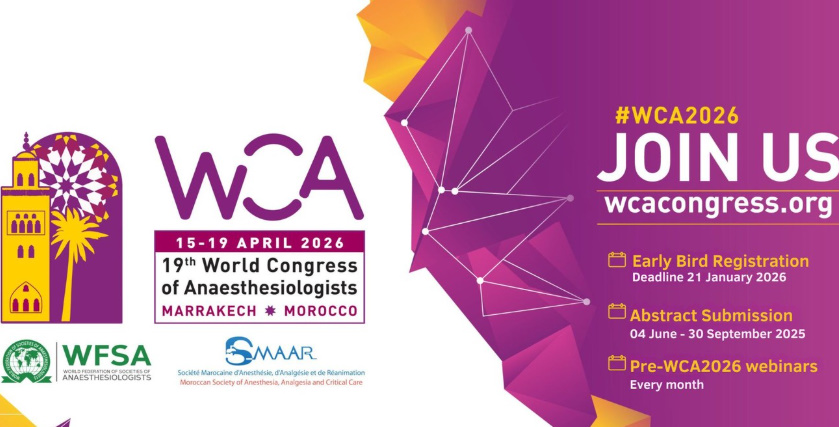
The World Federation of Societies of Anaesthesiologists 19th World Congress of Anaesthesiologists provides a massive, global perspective on the evolution and current challenges of modern anaesthesia. The program explores a wide array of disciplines, including advanced airway management, critical care, obstetric and pediatric anaesthesia, the integration of artificial intelligence, and strategies for global sustainability and patient safety.
Course Dates: April 16-19, 2026
In 2026, it heads to Morocco, marking a vibrant new chapter for this premier event. WCA2026 promises an extraordinary setting in the heart of North Africa, where anaesthesiologists and perioperative specialists from 130+ countries will converge to advance science, education, and collaboration in anaesthesia.
Against the stunning backdrop of Marrakech, WCA2026 will offer a uniquely immersive experience, fostering knowledge exchange, hands-on training, and meaningful global connections, all within a rich cultural landscape that amplifies the congress’s spirit of innovation and diversity.
2. Learning Objectives
-
Apply advanced airway management and ventilation strategies across diverse patient populations, including pediatric and critically ill cases.
-
Evaluate and implement innovations in perioperative pain management, neuroanaesthesia, and obstetric anesthesia to optimize patient outcomes.
-
Integrate artificial intelligence, big data analytics, and non-invasive monitoring into daily clinical decision-making.
-
Address global health challenges, including workforce shortages, medication access, and ethical issues in international partnerships.
-
Develop practical strategies for sustainability, the circular economy, and improving high-value care in both ambulatory and operating room settings.
3. Target Audience
Best for anesthesiologists, critical care physicians, and pain specialists who want updates on global anesthesia practices, airway management, and AI.
4. Topics
-
April 16 D.17.01 – Pro Con Debate
-
April 16 IND.01 Global Perspectives on Supply Chain Resilience Error from the original video publisher
-
April 16 L.01.01 – Oxygenation
-
April 16 L.01.02 Airway Pathologies
-
April 16 L.01.03 – Optimising Videolaryngos copy (VL)
-
April 16 L.01.04 – Supraglottic Airways
-
April 16 L.01.05 Awake Intubations
-
April 16 L.01.06 Patient at Risk for Aspiration
-
April 16 L.04.01 – Pulmonary Hypertension in Non-Cardiac Surgery
-
April 16 L.04.02 – The Changing Face Of Cardiac Anaesthesia
-
April 16 L.04.03 Congenital Heart Disease for Non Cardiac Surgery
-
April 16 L.04.04 Advanced Haemodynami c Monitoring in the Critically Ill Patient
-
April 16 L.04.05 Vasopressors and Inotropes in Septic Shock – New Directions
-
April 16 L.04.06 Cardiodynamic Considerations in Shock
-
April 16 L.05.01 – New Developments in Critical Care
-
April 16 L.05.02 Airway Management
-
April 16 L.11.02 Controversies in paediatric Pain Management, Bridging Theory to Practice
-
April 16 L.11.03 – Mastering the Paediatric Airway, Innovations and Best Practices in Anestthesia
-
April 16 L.11.04 – Sedation and Anasthesia Management in Padiatrics
-
April 16 L.11.05 Paediatric Cardiac Anaesthesia, From basic to Global Surgical Programmes
-
April 16 L.11.06 Education and Training in Paediatric Anaesthesia
-
April 16 L.12.02 – Optimising Perioperative Pain Management, Strategies and Solutions HFNC in Anesthesi…
-
April 16 L.12.03 Chronic Pain Patients, Anaesthesia Challenges
-
April 16 L.13.01 – Frailty and Ageing Perioperative Patient
-
April 16 L.13.02 Perioperative Fluid and Hoemodynamics
-
April 16 L.13.03Risk Assesment and Shared Decision Making
-
April 16 L.14.01 – Meet the Expert, TIVA and TCI
-
April 16 L.14.02 Updates in Pharmacology, Meet the Journal Editors
-
April 16 L.14.03 Neuroscience
-
April 16 L.14.04 Neuromuscular Block
-
April 16 L.14.05 Meet the Experts – Automation in Anaesthesia
-
April 16 L.15.01 – Gender – Is It Still a Source of Inequitymkv
-
April 16 L.15.02 How Do We Use Assessment To Support Wellbeing
-
April 16 L.15.03 Current Issues in Professional Practice
-
April 16 L.17.01 – Breast Surgery
-
April 16 L.17.02 – Abdominal Wall
-
April 16 L.17.03 Upper Limb
-
April 16 L.17.04 – Lower Limb
-
April 16 L.17.05 Chest Wall
-
April 16 L.18.01 – One Lung Ventilation
-
April 16 L.18.02 – HFNC in Anesthesia
-
April 16 L.18.03 – Meet the Experts – Brain Trauma and Ventilation
-
April 16 L.19.01 – Sad but True, Anaesthesia Safety During Disaster and Violence
-
April 16 L.19.02 – Is Our Work Unsafe When We Are Leaving the OR
-
April 16 L.19.03 – World Health Organization (WHO) Guidance on Implementing Patient Blood Managem…
-
April 16 L.19.04 Debate, Sustainability Versus Patient Safety, Do They Compete With Each Other
-
April 16 L11.01 – Non-invasive Monitoring and Standardisation in Pediatric Anaesthesia
-
April 16 L12.01 Chronic Presistent Postoperative Pain
-
April 16 SYMP.01 Continuous Noninvasive Blood Pressure Management, The New Standard
-
April 16 SYMP.02 Masimo Total Oxygen Delivery and Vital Organ Protection Platform , Optimizing Sedati…
-
April 16 SYMP.03 Innovation and Insights, Design a multimodal, data-integrated clinical pathway for opti…
-
April 16 SYMP.04 – Improving Patient Safety in the Operating Room
-
April 16 SYMP.08 Launching the Gradian Institute, Strenghtening Anesthesia and Critical Care Capacity
-
April 17 HGL – Harold Griffith Lecture, Can Anaestheologists Lead on Patient Safety Again
-
April 17 L.01.07 – Speciality Airway
-
April 17 L.01.08 Airway Management in the Critically Ill
-
April 17 L.01.09Airway Guidelnes
-
April 17 L.01.10 – Tracheotomy an Extubation
-
April 17 L.01.11 – Airway Management with Limited Ressources
-
April 17 L.05.04 Cancer in the ICU
-
April 17 L.06.01 Ethics in International Partnership
-
April 17 L.06.02 Accessing Grant Funding for Education and international Development initiatives in Glob…
-
April 17 L.06.03 Unwritten Lessons in Anaesthesia, How We Learn, Teach and Evolve
-
April 17 L.06.04 Training Medical Students in Anaesthesia, Preoperative Medicine Critical Care And Pain, Ex…
-
April 17 L.07.01 Comment Optimiser le Parcours en Chirurgie Majeure
-
April 17 L.07.02 – Comment Réduire la Morbi-Mortalité Maternelle
-
April 17 L.07.03 – Enejux de l’Anethésie Pediatrique
-
April 17 L.07.04 – Mise au Point en Neuro-Réanimation
-
April 17 L.07.05 – Gestion d’une Catastrophe au Bloc Opératoire ou Juste Après
-
April 17 L.08.01 Workforce Challenges, The Big Picture
-
April 17 L.08.02 – Workforce Storages Affect All Of Us, Challenges and Solutions From Around The World….
-
April 17 L.08.03 – Medication Access Plagues Us All
-
April 17 L.10.01 – Clinical Scenarios in Obstetric Anaesthesia and Analgesia
-
April 17 L.10.02 Management of Pain During Delivery, Improving Patient Care
-
April 17 L.10.03 Ultrasounds in Obstetric Anaesthesia
-
April 17 L.11.07 Next Generation Paediatric Anaesthesia, Safe Practices and Cutting-Edge Solutions
-
April 17 L.12.04 – Comprehensive Pain Management in Cancer Care, Best Practices and Innovations
-
April 17 L.12.05 – Decolonising Pain Management, a Global Perspective V2
-
April 17 L.13.04 perioperative Nutrition, Managing Obesity and Malnutrition
-
April 17 L.14.06 Artificial Intelligence In Anaesthesiology, Practical Applications and Innovations
-
April 17 L.14.07 AI-Enhanced Perioperative Care, From Analytics to Generative AI
-
April 17 L.14.08 Global Perspectives on AI, Multilingual Applications, Environmental Impact and Governan…
-
April 17 L.14.09 Lessons Learned From AI Implementation
-
April 17 L.14.10 Future of Anaesthesiology
-
April 17 L.17.06 Case-Based Discussions for The Regional Anaesthiologist
-
April 17 L.17.07 – Learning from Big Data
-
April 17 L.17.08 Opioids
-
April 17 L.17.09 The Future of Regional Anaesthesia
-
April 17 L.17.10 Safety and Complications
-
April 18 L.18.04 Lung Protection in the operating Room
-
April 18 L.18.05 – Mechanical Ventilation in Children
-
April 17 L.20.01 Circular Economy
-
April 17 L.20.02 – Implementing Solutions
-
April 17 L.20.03 Inhaled and Injectable Anaesthetics
-
April 17 SYMP.06 Desflurane in Modern Anaesthesia, Best Practices and Environmental Clarity
-
April 17 SYMP.07 Beyond the Pulse, Integrating Ultrasound and Cardiac Output Monitoring for Intraoper…
-
April 17 SYMP05 – From Innovation to Insights, Optimize Clinical Decisions in Perioperative Care
-
April 18 BBS. Best Basic Science Research Competition
-
April 18 BCR – Best Clinical Research Competition
-
April 18 FS1.15.01 – Unapologetically Ambitious Women in Leadership
-
April 18 L.02.01 Evolution of Ambulatory Anaesthesia
-
April 18 L.02.02 – Controversies in Ambulatory Anaesthesia
-
April 18 L.02.03 Non Operating Room Anaesthesia NORA
-
April 18 L.03.01 Oxygen – A Discussion of Its History and Accessibility
-
April 18 L.03.02 Ethical Issues in Anaesthesia
-
April 18 L.03.03 – Communicating Knowledge-A Journey Through the Ways and Means of Sharing Knowl…
-
April 18 L.04.07 Perioperative Haemodynamic Management
-
April 18 L.04.08 – New Insights Into Cardiovascular Disease Among the Critically Ill
-
April 18 L.04.09 – From Resuscitation to Deresuscitation
-
April 18 L.05.05 – Sepsis
-
April 18 L.05.06 ARDS In 2026
-
April 18 L.05.07 Status Epilepticus
-
April 18 L.05.08 Communication in the ICU
-
April 18 L.05.09 Artificial Intelligence in the ICU
-
April 18 L.09.01 – Recent Advances in Neuroscience
-
April 18 L.09.02 Traumatic brain and Spine Injury
-
April 18 L.09.03 – The Brain Hypotension
-
April 18 L.09.04 Postoperative Delirium
-
April 18 L.09.05 – The Electroencephalogram, EEG, During Anaesthesia
-
April 18 L.10.04 – Best Practice in Delivery Anaesthesia and Analgesia
-
April 18 L.10.05 Postpartum Haemorrhage
-
April 18 L.10.06 Obstetric Anaesthesia in LMIC
-
April 18 L.12.06 Undertreatment and Disparities in Management of Pain
-
April 18 L.13.05 – Diagnosis and Optimising Medical Conditions Before Surgery
-
April 18 L.13.06 Prehabilitation, The What, The WHy, The How
-
April 18 L.13.07 – Perioperative Blood Management
-
April 18 L.13.09 Perioperative Cancer Care
-
April 18 L.16.01 – AI, The Future of Research
-
April 18 L.16.02 Ethical Issues in Research and Publication
-
April 18 L.16.03 Tips and Tricks to Succeed in my Submission
-
April 18 L.16.04 – How to Improve the Impact of My Future Publication
-
April 18 L.18.06 – Innovations in Ventilation
-
April 18 L.18.07 Pulmonary Phisiology in the Operating Room
-
April 18 SYMP.09 Global Data, Local Impact, LASOS-Peds and the Future of Pediatric Surgical Equity
-
April 18 WFSA Innovation Awards
-
April 19 L.02.04 – Sate of The Art Care in Ambulatory Anaesthesia
-
April 19 L.02.05 Patient Selection in Ambulatory Anaesthesia
-
April 19 L.05.10 Magic Drugs
-
April 19 L.05.11 Avoiding Intubation
-
April 19 L.06.05 Low-Cost Innovative Options for Medical Education
-
April 19 L.06.06 Artificial Intelligence in Medical Education
-
April 19 L.09.06 – Neuroanaesthetic Challenges
-
April 19 L.09.07 – Stroke
-
April 19 L.10.09 – Pearls in Obstetric Anaesthesia an Analgesia
-
April 19 L.10.10 – Care of The Pregnant Patient With Comorbidity
-
April 19 L.13.10 Global Perspectives on Improving Surgical Outcome and High-Value Care
-
April 19 L.13.11 Enhanced recovery and Post Op Care
-
April 19 L.15.04 Culture – When Is It a Source of Inequity
-
April 19 L.15.05 – Well-Being Leading Out of Adversity
-
April 19 L.19.05 – Education in Patient Safety – What Are the Opportunities
-
April 19 L.19.06 – Safety and Advantages of New and Old Drugs


Reviews
There are no reviews yet.